The Audemars Piguet Royal Oak Perpetual Calendar — ref. 26574ST — is not a watch you stumble into. It sits at the absolute apex of AP’s steel sports watch lineage, a 41mm perpetual calendar built around the in-house Cal. 5134 with a moon phase complication that’s accurate to one day in 122 years. Retail? North of $70,000 USD. It’s a watch that demands serious horological credentials from anyone who wears it. And now, the grey-market clone factories have taken their most ambitious swing at it. So let’s talk about what they actually delivered.
I’ve had this piece on my wrist for three weeks. I’ve been under a 10x loupe, I’ve photographed it next to reference images of the genuine article, and I’ve worn it through the full gamut — boardrooms, dive bars, airport lounges. What follows is the unfiltered, technically honest assessment you’re not going to get from the promotional copy written in Shenzhen.
Confronting the Clone: Why the 26574ST Is the Hardest AP to Fake
Most Royal Oak clones target the 15202 or the 15500 — simpler three-hand configurations where the dial is relatively uncluttered and the movement inside just needs to tick convincingly. The 26574ST is a completely different animal. You’re dealing with a perpetual calendar. That means four additional sub-dials — day, date, month, and moon phase — all crammed into the iconic tapisserie dial without destroying AP’s legendary visual balance. The genuine Cal. 5134 is a 374-component movement with a 40-hour power reserve and a 19,800 vph beat rate. It’s one of the most legible perpetual calendar dials ever executed in watchmaking.
This is exactly why clone manufacturers fear this reference. There’s nowhere to hide. Every sub-dial proportion, every hand-stack clearance, every printed index has to sit in precise geometric harmony with the others or the whole composition collapses. The factory behind this piece claims a “custom Cal. 5134” movement and 316L stainless steel with CNC-processed finishing. Bold claims. Let’s see if the execution backs them up.
The Dial Execution: Where the Devil Lives in the Details
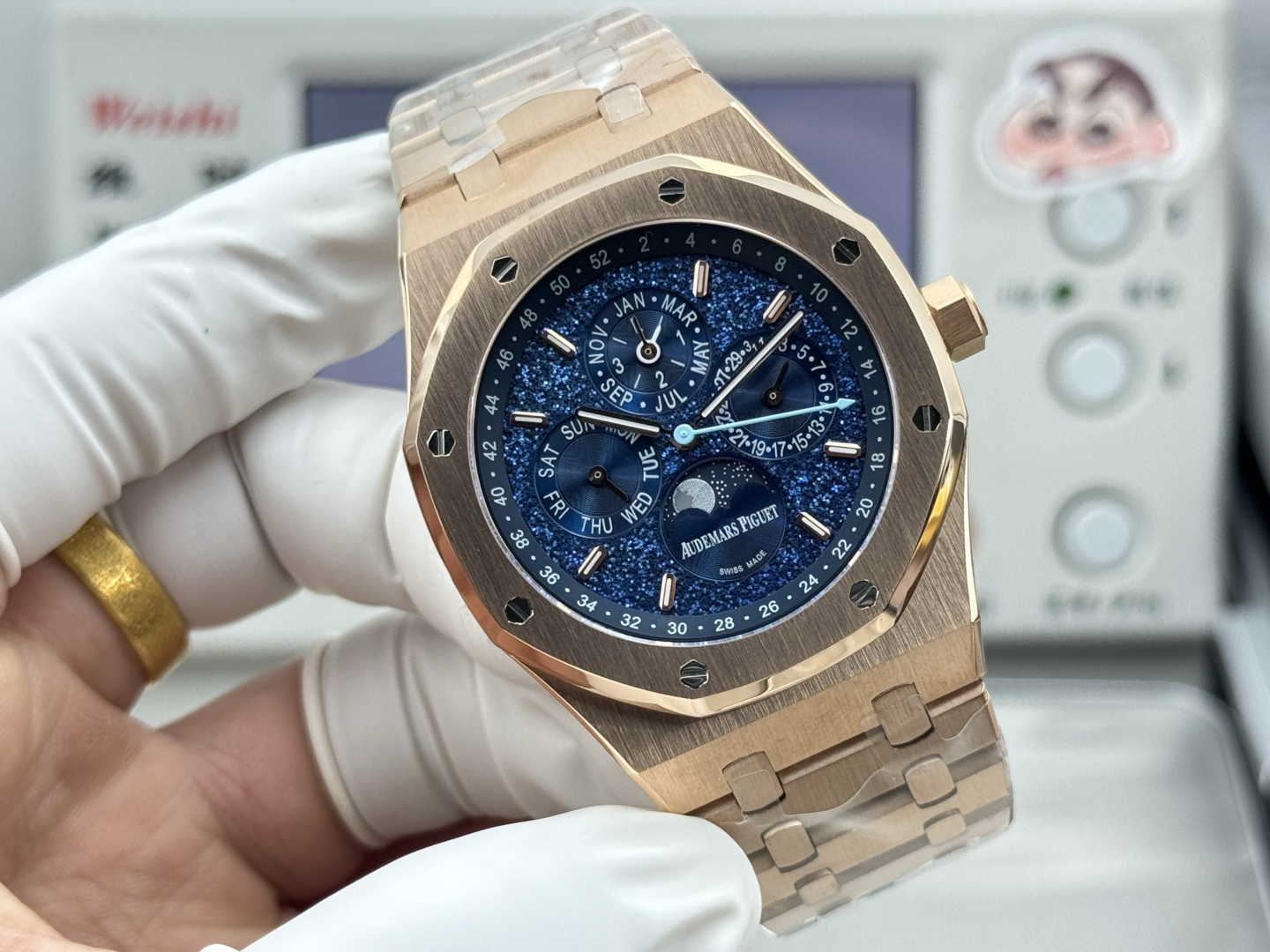
The tapisserie guilloché on the genuine 26574ST is machined directly into the dial plate — a raised, three-dimensional texture that catches light differently from every angle. On the clone, this is where you start to see the compromises almost immediately under magnification. The pattern is present and recognizable, but it’s shallower. The peaks of each square pyramid lack the crisp, almost razor-sharp definition of the AP-machined original. Under the 10x loupe, the genuine article looks like a micro-architectural grid; the clone looks like a very good photograph of that grid printed on a slightly soft surface. It’s subtle. At arm’s length, across a dinner table, nobody is catching this. But it’s there.
The sub-dial layout — day at 10 o’clock, date at 4, month at 8, and the moon phase aperture at 6 — is geometrically accurate in terms of positioning. Whoever did the dial template work here was clearly working from a high-resolution reference. The proportions are right. What betrays the clone is the pad-printing quality on the sub-dial chapter rings and the text. On the genuine, the typography for “AUDEMARS PIGUET” and “ROYAL OAK” is applied with a crispness that borders on the surgical — the kerning is tight, the letterforms are consistent, and there’s zero feathering at the edges of each character. On this clone, running a loupe across the brand signature reveals minor ink bleed on the letters “M” and “G” in particular. The serifs on the typeface are slightly heavier than they should be, giving the text a fractionally bolder appearance that doesn’t match the refined, almost etched quality of the original.
The moon phase disc deserves its own paragraph. The genuine 26574ST features a deep blue moon phase disc with hand-applied gold stars — a detail that’s genuinely beautiful and technically demanding. The clone uses a printed disc. The stars are flat, printed in gold ink rather than applied as individual elements. The moon itself is rendered competently, but the depth and dimensionality of the original is simply absent. This is not a catastrophic failure — it reads correctly from normal viewing distance — but it’s a meaningful downgrade in execution.
The tapisserie pattern on a genuine AP is a machined topography. On this clone, it’s a very convincing approximation — and in watchmaking, “very convincing approximation” and “correct” are not the same sentence.
Lume application on the indices is adequate. The applied baguette indices themselves are well-fitted to the dial — no visible gaps, no lifting at the edges. The lume fill is even and charges reasonably under UV. Nothing to complain about here; it’s actually one of the stronger elements of the dial package.
Wearability & SEL Flushness: The Bracelet Question
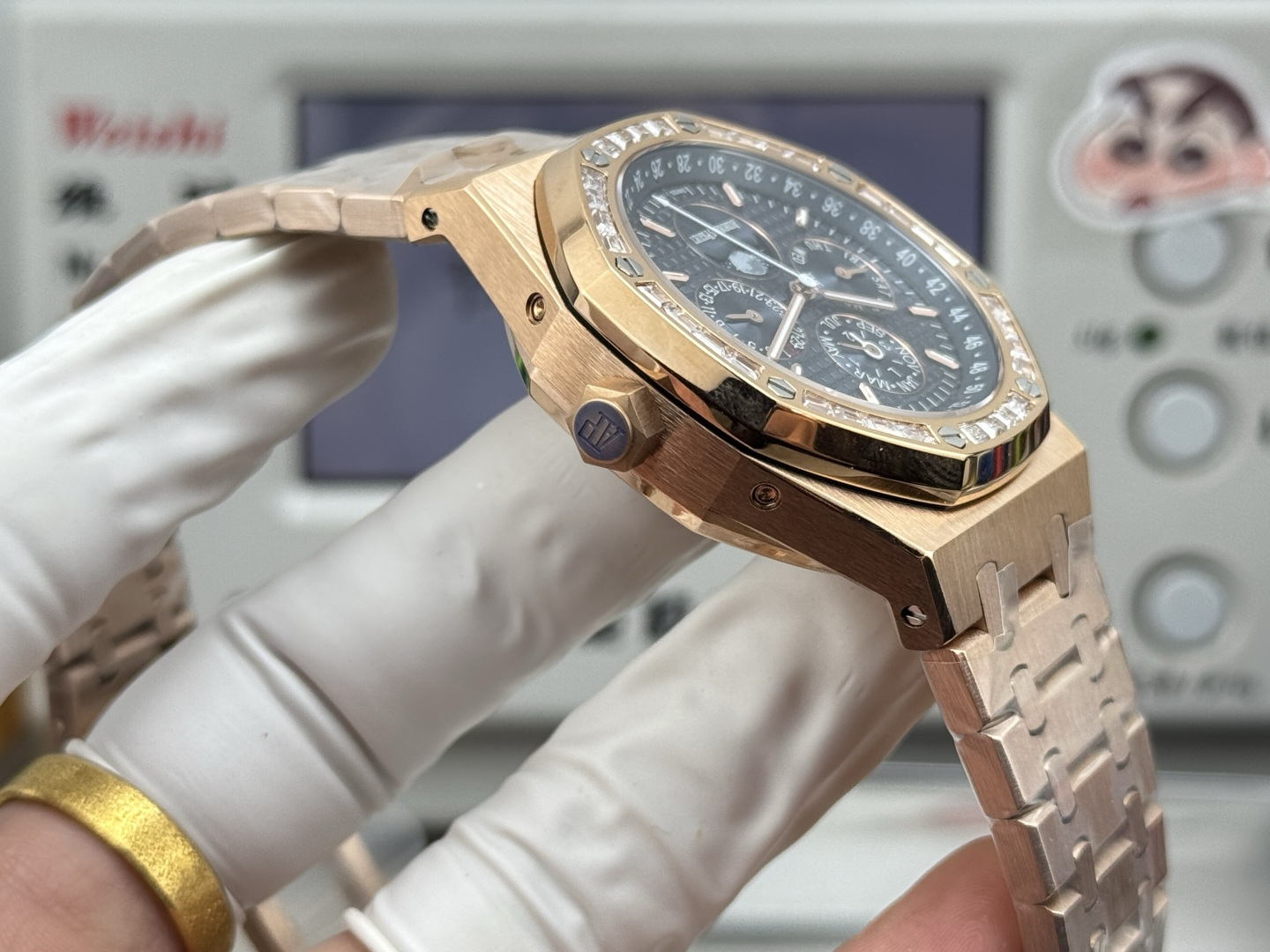
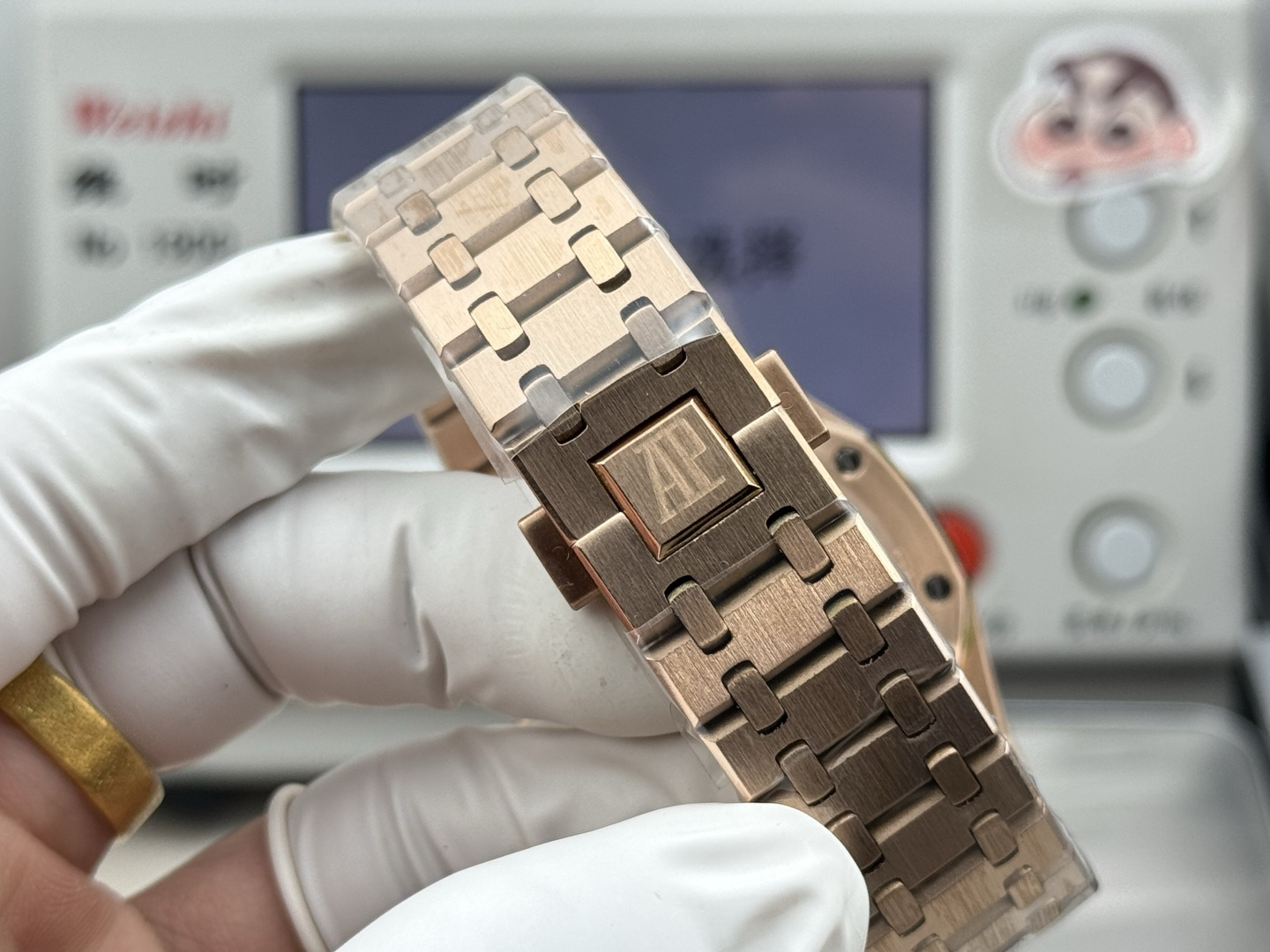
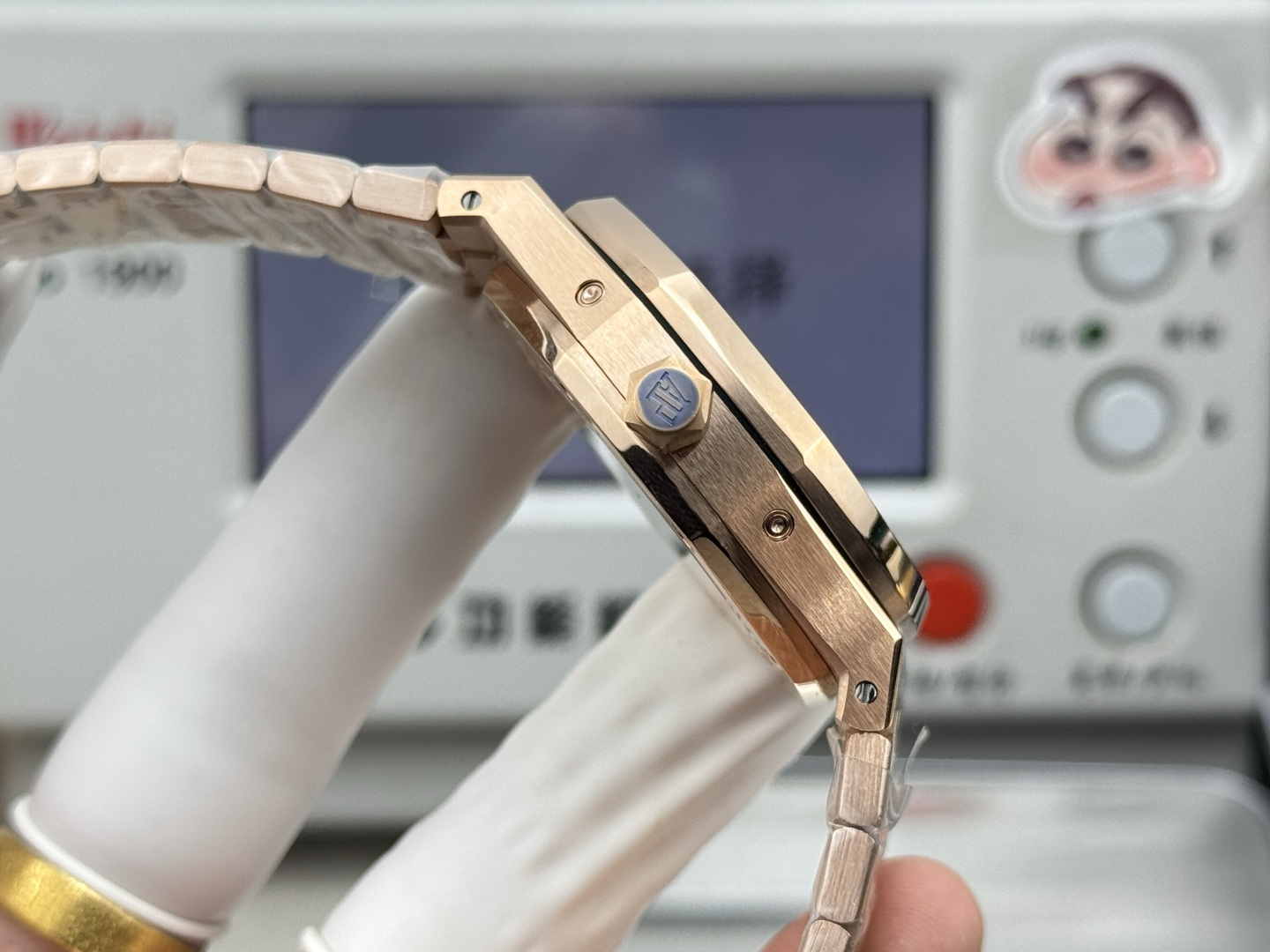
The Royal Oak’s integrated bracelet is the single most technically demanding element of the entire watch to replicate. The SEL articulation on the genuine AP is a masterclass in engineering — each link transitions with a weighted, almost liquid smoothness, and the solid end links sit flush against the case at a specific angle that required AP’s engineers years to perfect. The bracelet taper from 20mm at the case to the deployant clasp is executed with a precision that makes lesser bracelets feel like cheap toys by comparison.
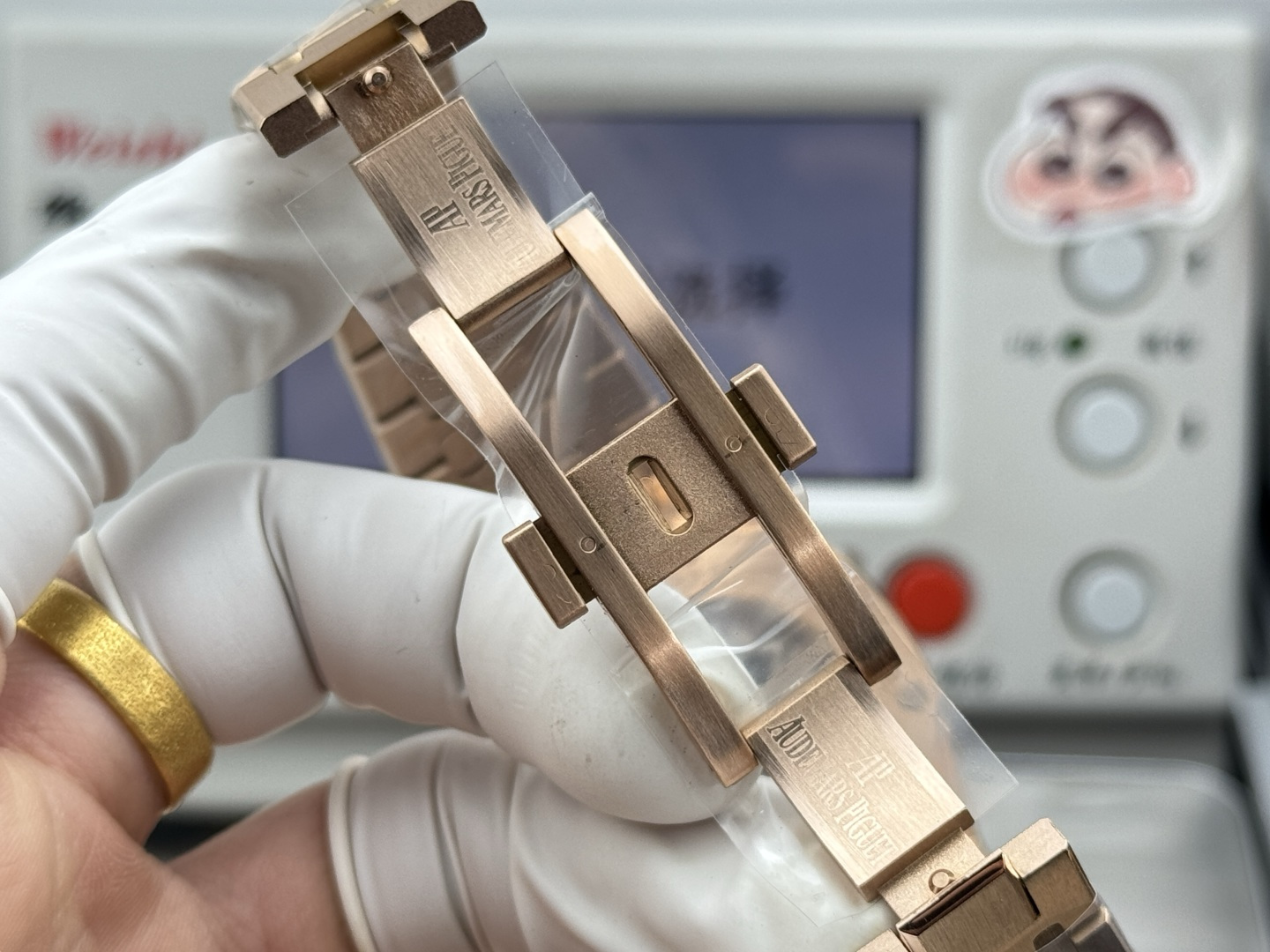
On this clone, the bracelet is the second-best thing about the package, which is either encouraging or damning depending on your perspective. The SEL flushness is close — genuinely close. The integration angle is right. The links articulate without that cheap rattle that plagued earlier-generation AP replicas. The satin-brushed finishing on the flat surfaces and the polished chamfering on the edges are executed with reasonable competence. The deployant clasp functions properly and has a satisfying, if slightly hollow-sounding, click on closure.
Where it falls apart is in the micro-details of the brushing direction. On a genuine Royal Oak bracelet, the satin finishing is applied with a consistency and depth that gives the steel a almost velvety directional texture. On this clone, the brushing is slightly inconsistent across the individual links — some links read slightly brighter, some slightly duller, suggesting the finishing process lacks the uniformity of the original. It’s a 10x loupe observation, not a naked-eye failure, but it’s there.
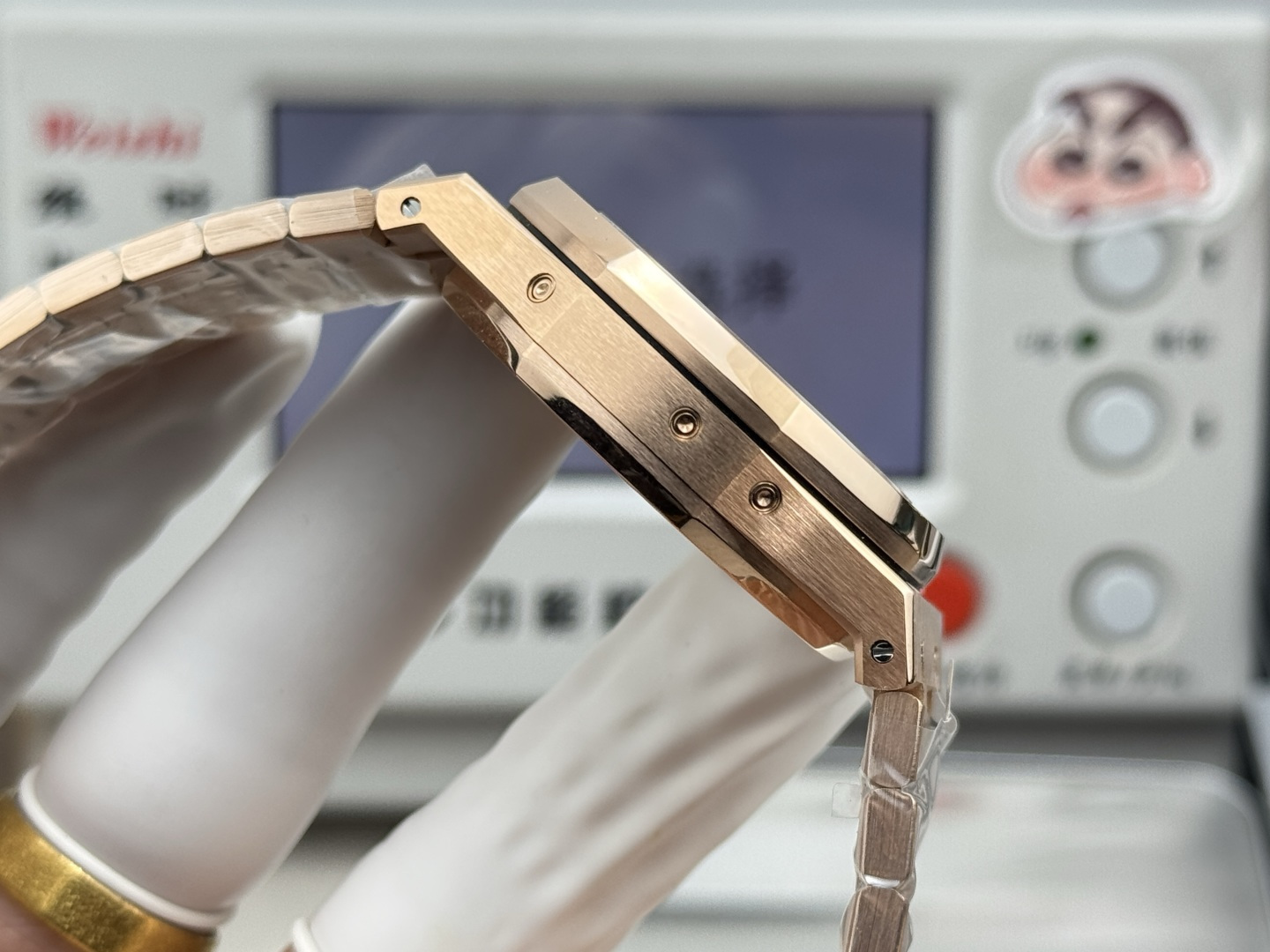
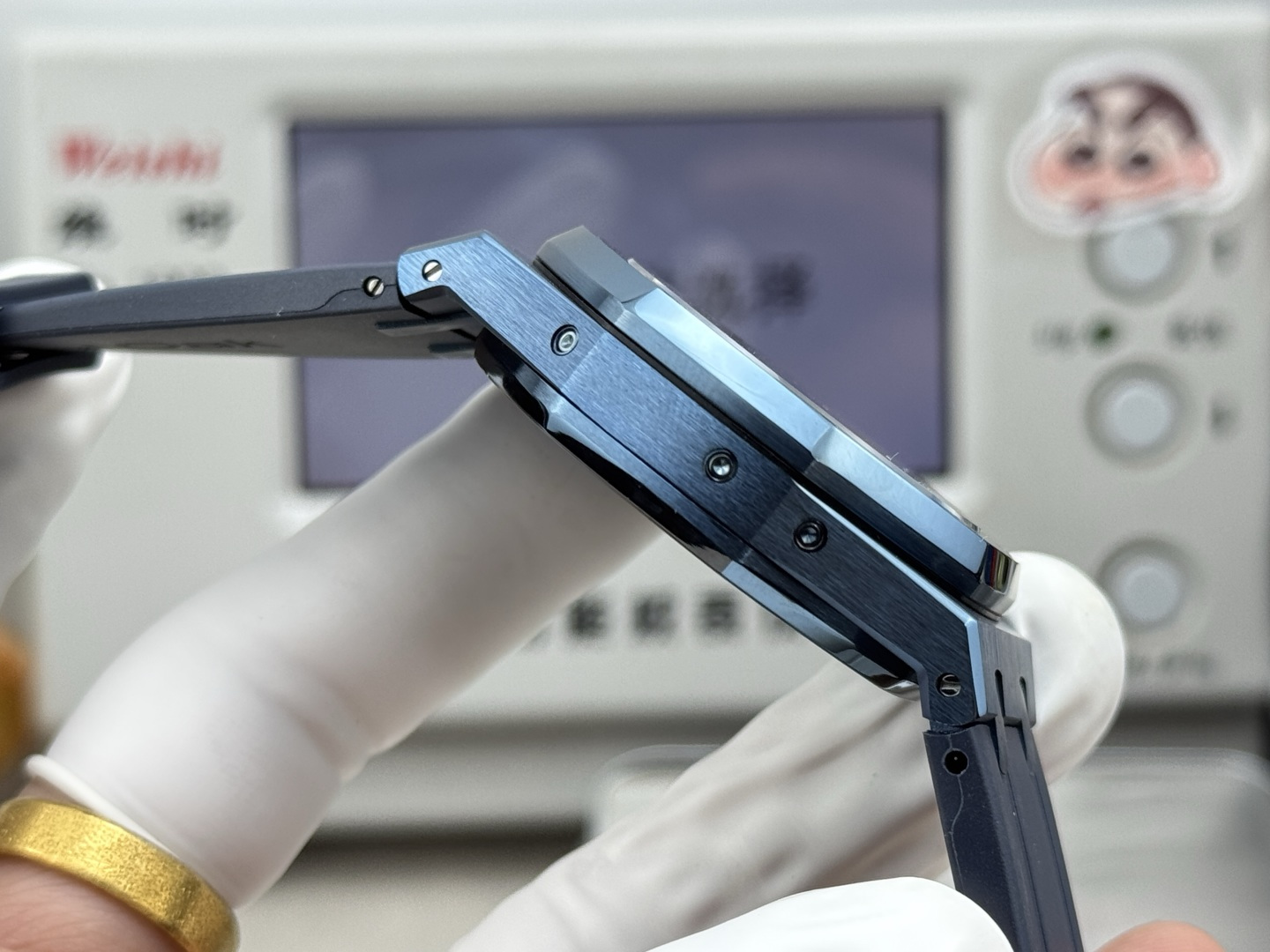
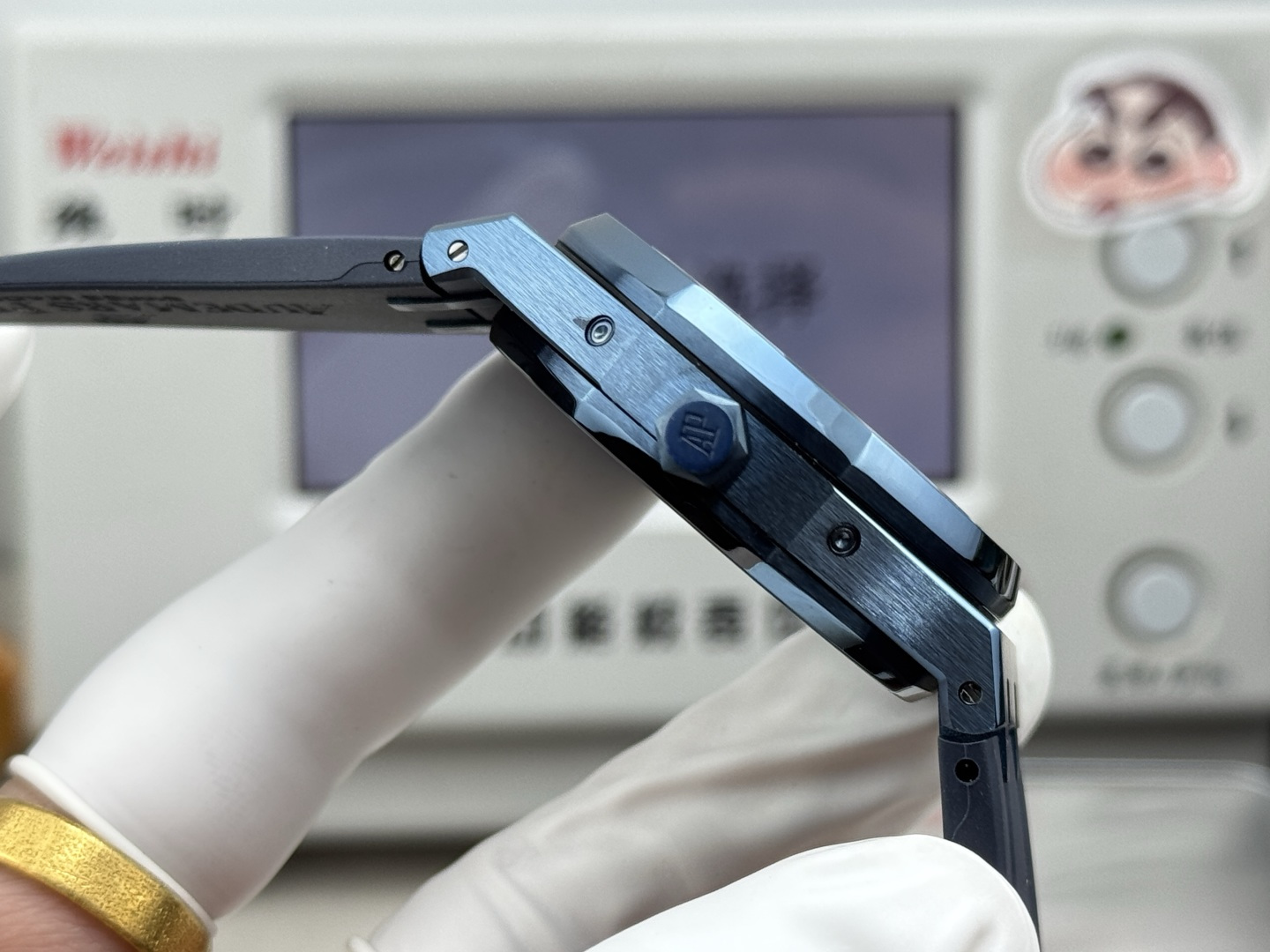
The 41mm case wears beautifully. Lug-to-lug dimensions are correct, and the ergonomics on the wrist are exactly what you’d expect from this case architecture. The crown has appropriate resistance and the winding action is smooth enough that I have no serious complaints.
Mechanical Execution: The “Custom Cal. 5134” Claim
Let’s be direct about what “custom Cal. 5134” means in the context of a clone manufacturer’s product sheet. It does not mean a 374-component perpetual calendar movement manufactured to Geneva Seal standards. What it means, in practical terms, is a movement that executes all the calendar functions — day, date, month, moon phase — and does so reliably. The perpetual calendar mechanism on this clone does function. All four complications respond correctly to the quick-set pushers integrated into the case. The moon phase advances. The month display cycles properly. This is not nothing — executing a working perpetual calendar at this price point requires genuine engineering effort, and the factory deserves credit for not cutting corners and delivering a display-only or non-functional complication.
A clone movement that actually executes a perpetual calendar is worth more respect than a clone movement with a pretty rotor and nothing behind it. Function matters. But let’s not confuse “it works” with “it’s good.”
The movement finishing, visible through the exhibition caseback, tells the more honest story. The Côtes de Genève striping on the bridges is present but lacks the depth and regularity of the genuine article. The perlage on the mainplate is there in concept — circular graining applied to the surfaces — but the pattern is less uniform than AP’s in-house finishing. The rotor has a satin-brushed finish that’s acceptable but shows none of the hand-beveled anglage that makes the genuine Cal. 5134’s rotor such a pleasure to observe. The balance wheel runs at a beat rate that feels correct — I don’t have a timing machine on me right now, but the watch has kept time within roughly ±15 seconds per day across my testing period, which is honestly better than I expected.
The Definitive Flaw
If I had to identify the single element that would betray this watch to a knowledgeable observer in a casual social setting — not under a loupe, just in normal light — it’s the AR coating on the sapphire crystal. The genuine AP 26574ST uses a multi-layer anti-reflective coating that produces a very specific, very subtle blue-green bloom when light hits the crystal at a low angle. It’s a recognizable visual signature that AP collectors know intimately. The clone’s crystal produces a different bloom — more of a flat blue, slightly more aggressive in its reflectivity, without the nuanced color shift of the original. It’s the kind of detail that a non-collector will never notice. But anyone who has spent real time around genuine Royal Oaks will clock it within thirty seconds of picking up the watch.
Final Takeaway
This is the most technically ambitious AP clone I’ve handled. The perpetual calendar functions work. The case architecture is accurate. The bracelet integration is the best I’ve seen on a Royal Oak replica at this tier. And yet the cumulative weight of the compromises — the shallow guilloché, the pad-printing quality on the typography, the moon phase disc, the AR coating bloom — means this sits firmly in the category of “impressive clone” rather than “dangerous fake.” For grey-market collectors who understand exactly what they’re buying, this represents a genuinely interesting piece. For anyone trying to pass this off as the real thing to someone who actually knows the 26574ST? The loupe will find you.