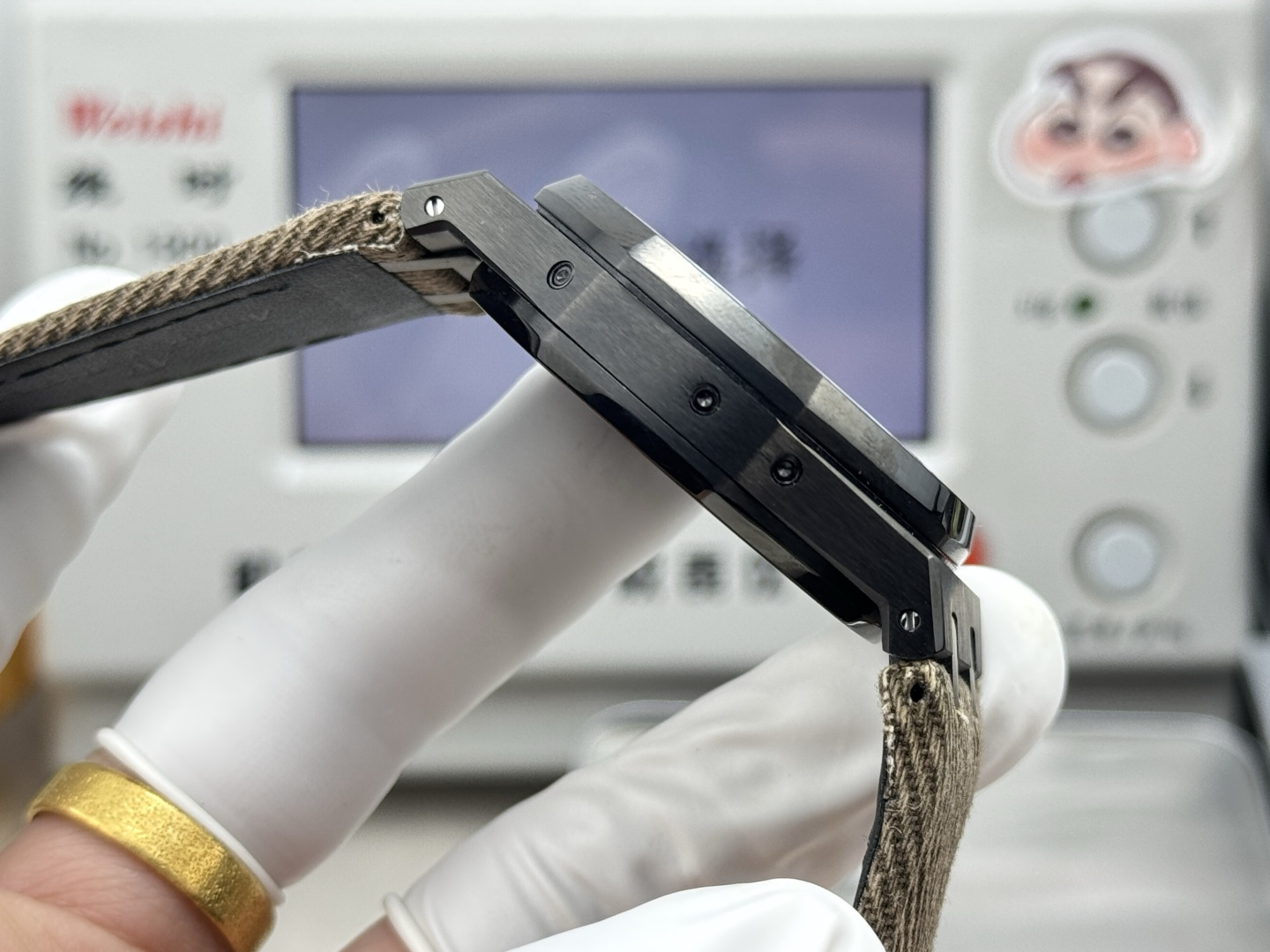
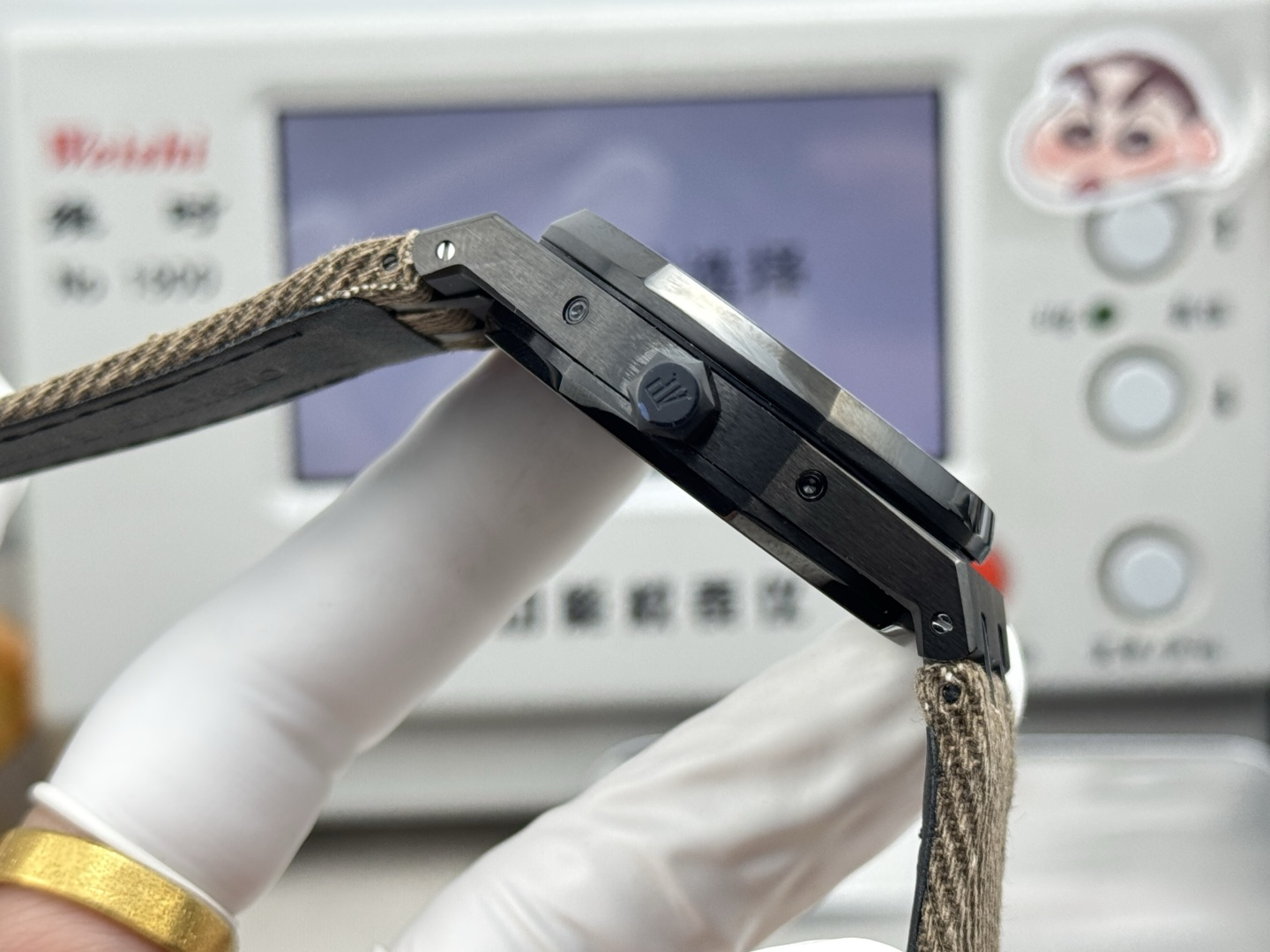
Let’s be honest about something. The Audemars Piguet Royal Oak Perpetual Calendar — reference 26574ST — retails somewhere north of $80,000 USD. And that’s if AP’s boutique staff even deign to let you buy one. The waiting list for this particular configuration, the 41mm steel perpetual with the iconic tapisserie dial and full calendar complication stack, is a bureaucratic nightmare dressed up in white gloves and champagne. You’ll need a purchase history. You’ll need a relationship manager. You might need to buy two or three other pieces first just to earn the privilege of spending eighty grand. It is, frankly, one of the more absurd rituals in contemporary luxury retail, and the grey market has been laughing at it for years.
So when a 1:1 clone of the 26574ST lands on my desk — spec’d with a custom Cal. 5134 movement, 316L stainless steel case, full perpetual calendar functionality, and a stated 41mm diameter — I’m not going to pretend I’m above examining it carefully. This is what I do. And this particular piece, at least on paper, is making some ambitious claims.
The Retail Absurdity
The genuine 26574ST is a complication watch in the truest sense. AP’s in-house caliber 5134 is a perpetual calendar movement — it tracks the day, date, month, and moon phase, accounting automatically for months of varying lengths without requiring manual correction until the year 2100. That’s not a trivial engineering achievement. The movement is also exceptionally thin for what it does, which is why the Royal Oak perpetual wears so elegantly on the wrist despite packing a mechanism with hundreds of additional components compared to a simple time-only.
The boutique experience surrounding this watch, however, has become a parody of itself. AP has masterfully weaponized scarcity in steel. The result is a secondary market where these pieces trade at significant premiums, and a grey-market clone industry that has every financial incentive in the world to produce convincing facsimiles. When the brand itself creates this kind of artificial demand theatre, it shouldn’t surprise anyone that the replica market responds with increasingly sophisticated products.
When a brand prices a man out of a watch he can technically afford, and then makes him beg for the privilege of buying it anyway, the grey market isn’t the villain in that story. AP wrote this script themselves.
First Impressions & The Weight of Steel
Out of the packaging, the first thing you register is the weight. The 316L stainless steel case has reasonable heft — not the precise 150-odd grams of the genuine article on its integrated bracelet, but it sits in the hand with credible density. The Chinese spec sheet claims the shell underwent CNC high-precision processing with density matching the original, and while that’s marketing language, the dimensional work here is genuinely not embarrassing. The 41mm diameter checks out on calipers. Lug-to-lug is close.
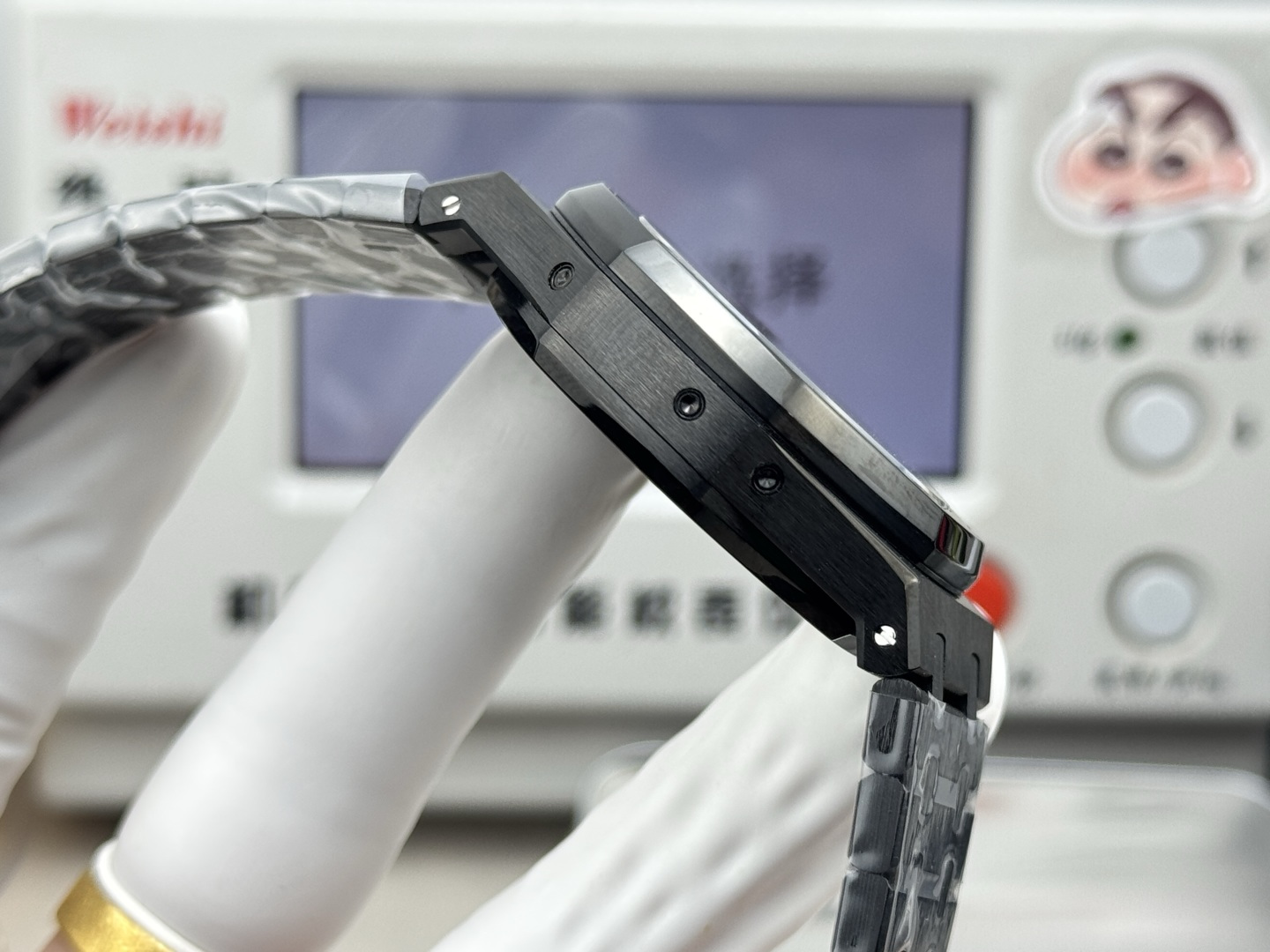
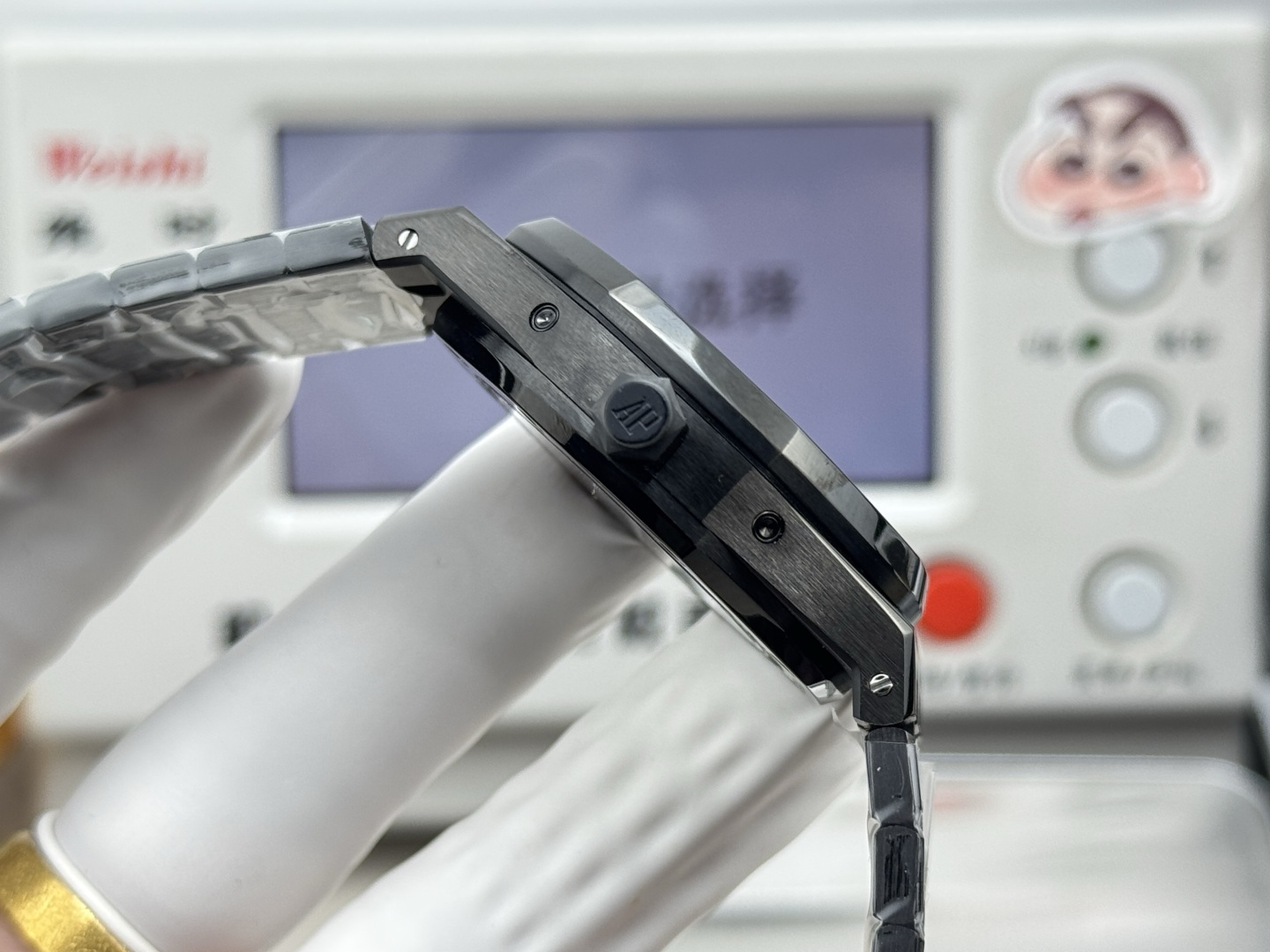
The bezel is where my attention immediately locks. The Royal Oak’s octagonal bezel with its eight exposed hexagonal screws is the most recognized design signature in modern watchmaking. On the genuine piece, those screws are polished and sit with absolute geometric precision in machined recesses. On this clone, the screws are present, they’re polished, and under casual inspection they pass. Under a 10x loupe, the story gets more complicated — the chamfering on the bezel edges shows inconsistency, particularly at the corners where the brushed and polished surfaces meet. On an authentic 26574ST, those transitions are surgical. Here, they’re close but slightly soft, as if the finishing wheel touched the surface a fraction too long at the junction points.
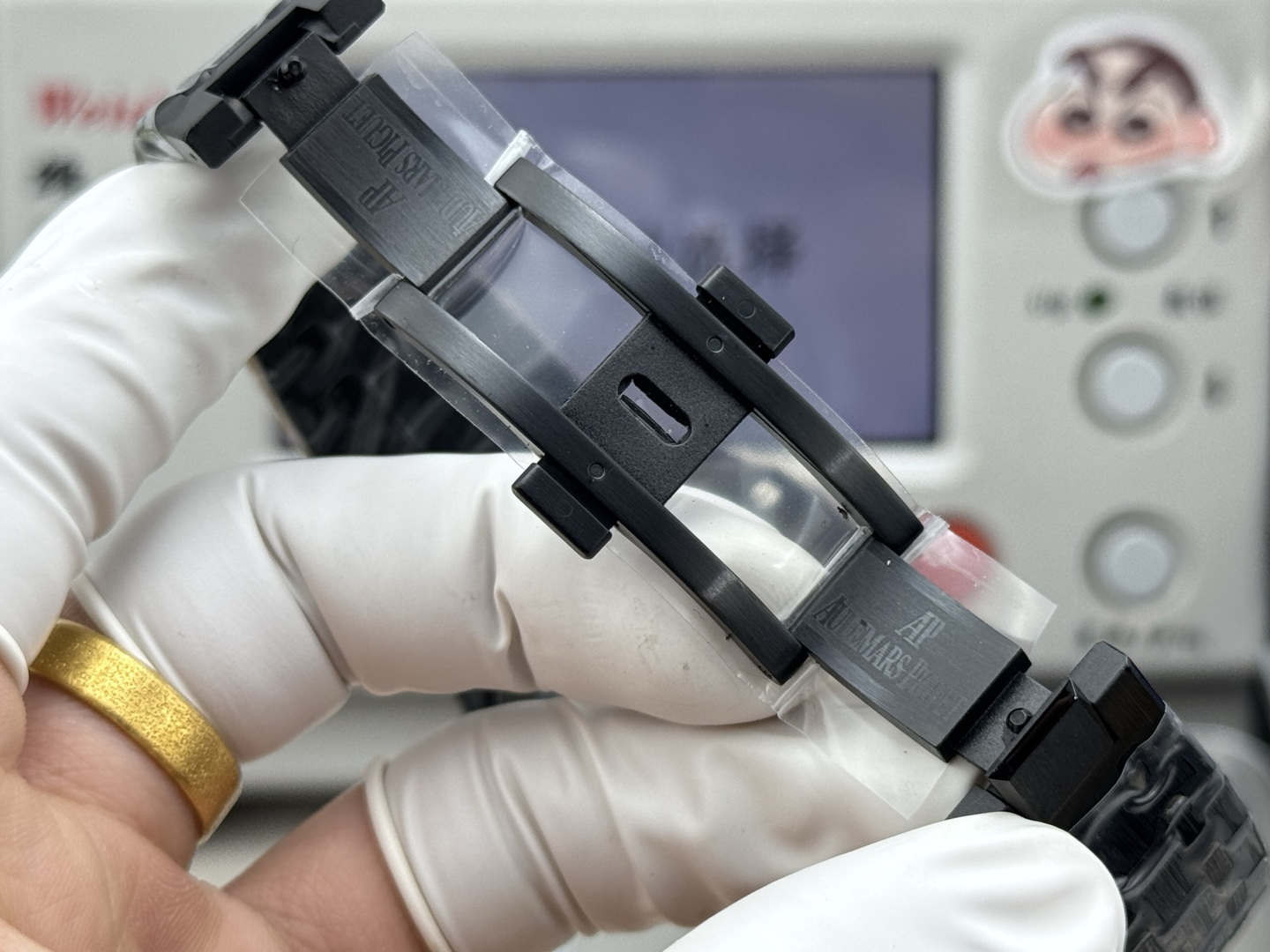
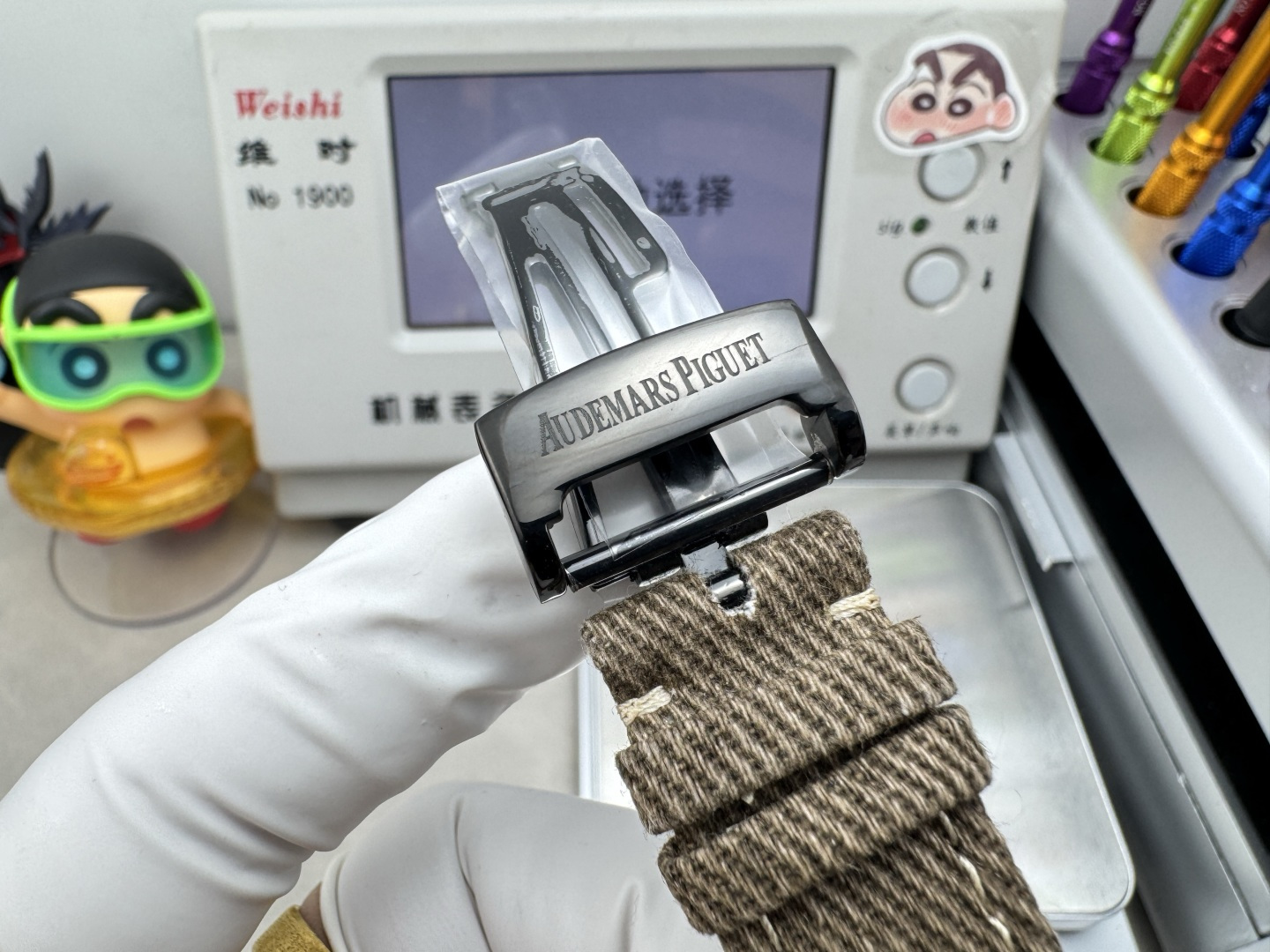
The bracelet — and this piece was reviewed on the steel configuration — shows SEL articulation that is functional and smooth. The deployant clasp operates without the sticky, gritty resistance you find on lower-tier clones. The integrated bracelet taper from case to clasp follows the correct proportions. Wearing it, the ergonomics are surprisingly good. The case sits flat on the wrist in a way that cheaper replicas often fail to achieve because they get the lug geometry wrong. This one doesn’t entirely fail that test.
Optical Illusions: The Dial Under Glass
Here is where I need to spend serious time, because the dial of the Royal Oak perpetual is one of the most demanding surfaces in watchmaking to replicate convincingly. The genuine 26574ST features the Grande Tapisserie pattern — a raised, three-dimensional chequerboard texture across the entire dial surface that interacts with light in a very specific way. The pattern has depth. Under direct light, it produces a shifting, almost holographic effect as you tilt the watch. AP achieves this through a stamping and galvanic process that creates genuine topographic relief on the dial plate.
On this clone, the tapisserie pattern is present and immediately recognizable. The grid proportions look correct at arm’s length. But place it under a loupe and the relief depth is noticeably shallower than the genuine article. The peaks of the pattern on a real 26574ST have a crispness — almost a knife-edge quality — that this dial doesn’t quite replicate. The texture reads as slightly flatter, slightly more uniform, which paradoxically makes it look more mechanical and less handcrafted. The genuine dial has microscopic imperfections in the pattern that are the byproduct of real tooling and real metalwork. This one is too consistent in the wrong way.
The sub-dials for day, date, and month sit at the 9, 12, and 3 o’clock positions respectively, with the moon phase aperture at 6. The typography kerning on the day and month displays is one of the most telling details on any perpetual calendar clone. AP uses a very specific typeface with precise letter spacing that is easy to get approximately right and very hard to get exactly right. On this piece, the month abbreviations — JAN, FEB, MAR and so on — are passable but the spacing between characters is marginally too wide. It’s subtle. Most people would never notice. I notice it immediately.
The AR coating on the sapphire crystal produces a blue-green bloom that is reasonably convincing. Genuine AP crystals show a very specific blue bloom that shifts toward green at oblique angles. This clone’s bloom is slightly more uniform in its blue cast and doesn’t shift as dynamically with angle, suggesting a single-layer AR treatment rather than the multi-layer coating on the original. Hand-stack clearance over the sub-dials is adequate — no dragging, no contact issues during operation.
The tapisserie pattern on this dial is like a photocopy of a painting. The content is all there. The texture, the depth, the thing that makes it alive — that’s what doesn’t survive the reproduction process.
Under the Caseback & Exposing ‘The Tell’
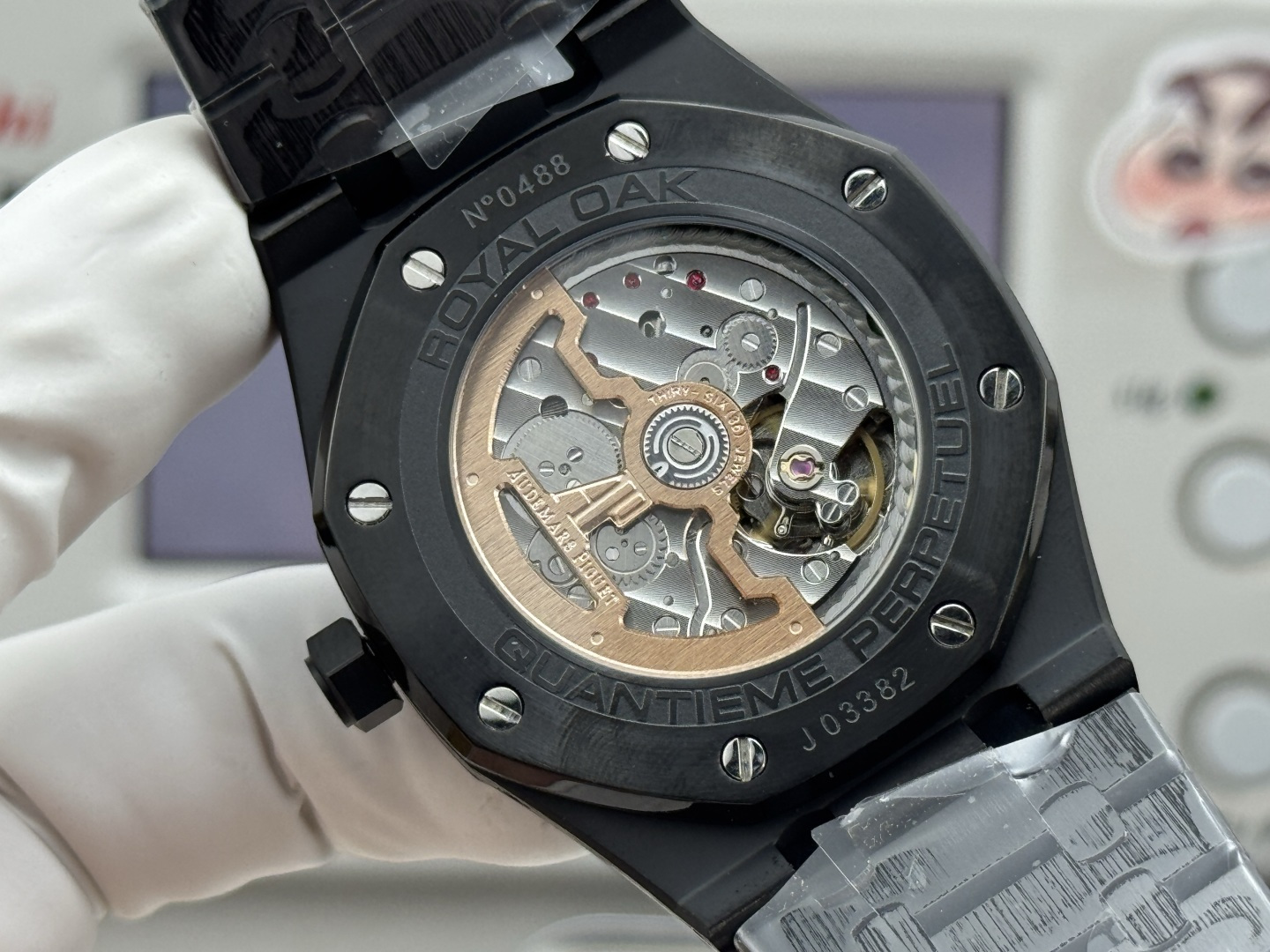
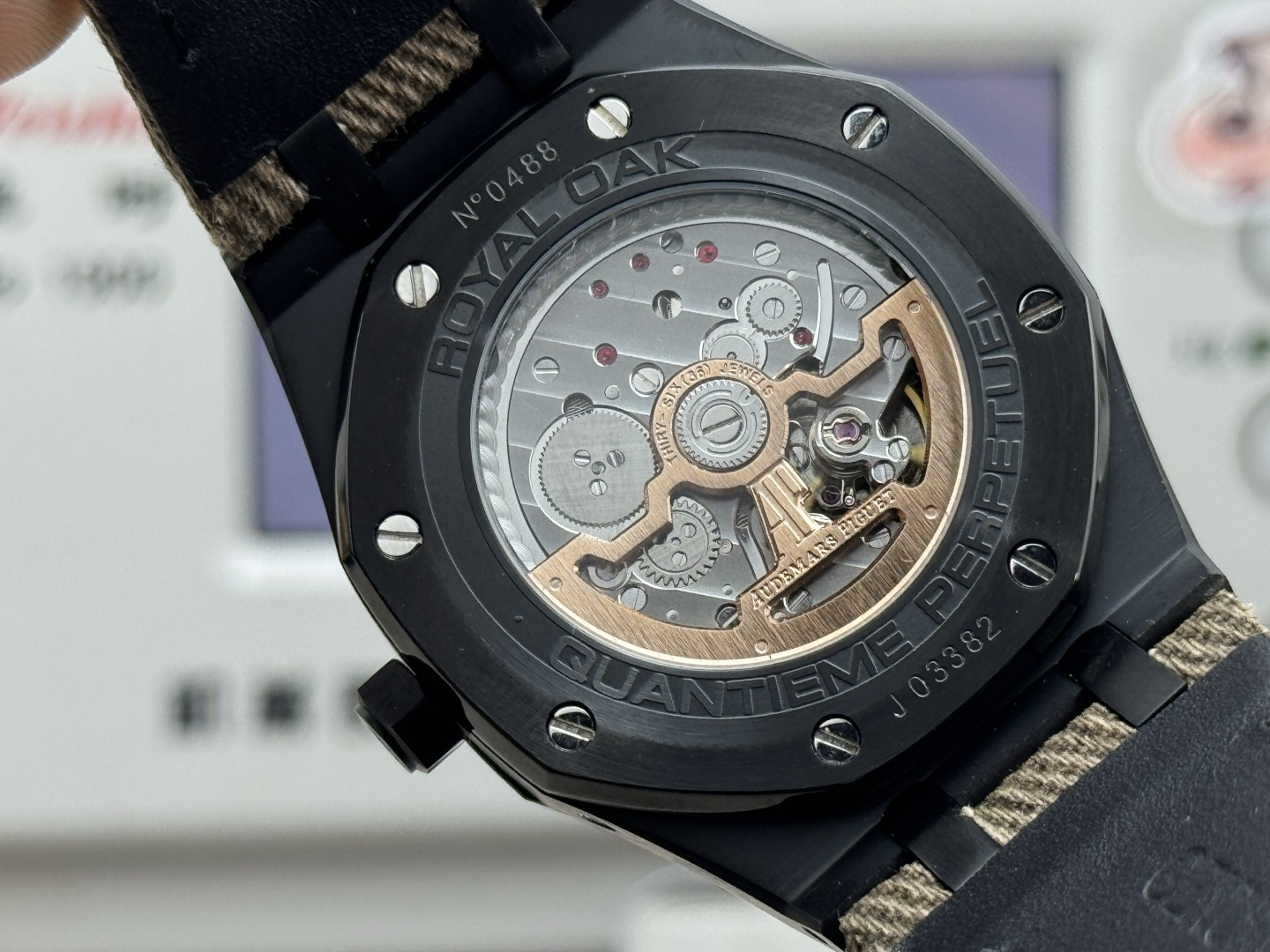
The movement is where the fundamental honesty of any replica lives or dies. This piece runs on what the vendor calls a custom Cal. 5134 — a clone of AP’s genuine caliber 5134 perpetual calendar movement. Let’s be clear about what that means in practice. The genuine 5134 is an in-house AP movement with exceptional hand-finishing: Côtes de Genève striping on the bridges, perlage on the mainplate, black-polished anglage on every component edge, and a rotor with chamfered spokes finished to jeweler standards. The beat rate runs at 19,800 vph (2.75 Hz), which gives the seconds hand a slightly lazy sweep that is characteristic of the piece.
Opening the caseback — and the three-piece case construction here is shell, bezel, and caseback as specified, which is correct — reveals a movement that is visually organized in the manner of a perpetual calendar. The calendar mechanism components are present and the functions do operate: advancing the date wheel manually, watching the month display click forward, seeing the moon phase disk rotate. Functionally, for daily wearing purposes, this movement does what it claims to do.
But the finishing. The Côtes de Genève on the bridges is machine-applied and shows the tell-tale uniformity of a CNC process rather than hand-applied striping — the lines are too perfect in their spacing and too shallow in their depth. The rotor, on a genuine 5134, has a 22-carat gold oscillating weight with anglage that catches light like a mirror. Here, the rotor is a brushed metal component that gets the shape approximately right but none of the surface finishing. The balance wheel runs — amplitude seems reasonable, the watch keeps acceptable time in my initial tests — but there is no visible perlage on the mainplate visible through the exhibition caseback window, just a flat, grey surface that tells you exactly where the manufacturing budget was allocated.
This is The Tell, and it’s always the movement. Every single time. You can get the case geometry close. You can get the dial pattern close. You can get the bracelet weight close. But finishing a movement to haute horlogerie standards requires human hands, time, and skill that cannot be replicated at this price point. The caseback window, rather than being a feature, becomes a confession.
The Question That Doesn’t Go Away
Here is the thing I keep returning to after spending two days with this piece. The 26574ST clone is, by the standards of the replica market, a genuinely competent piece of industrial production. The case work is better than most. The dial, despite its shallow tapisserie and slightly loose typography, reads correctly from social distance. The perpetual calendar functions work. Someone wearing this at a dinner table, across from someone who owns the genuine article, might — might — get away with it.
But that framing already tells you something uncomfortable about what we’re actually evaluating here. We’re grading on a curve that has nothing to do with watchmaking and everything to do with performance and deception distance. The genuine 26574ST exists as a functional art object, a mechanical calendar that will accurately track the Gregorian calendar for generations, finished by craftspeople whose skill represents decades of accumulated practice. This clone exists to look like that object from a comfortable social distance.
Whether that’s enough depends entirely on what you’re actually buying it for. And that’s a question only you can answer — but I’d encourage you to answer it honestly, because the movement under that caseback certainly will.