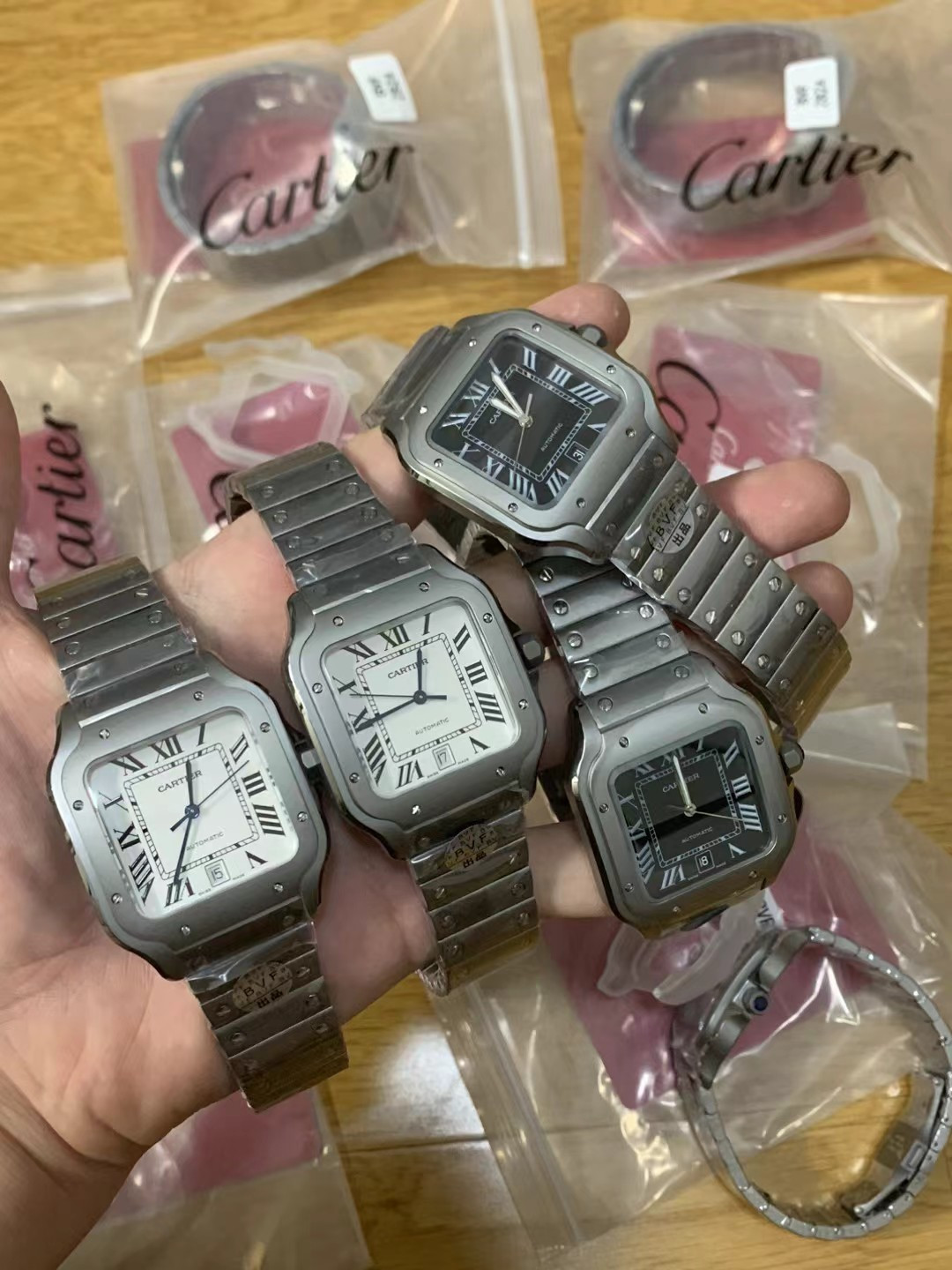
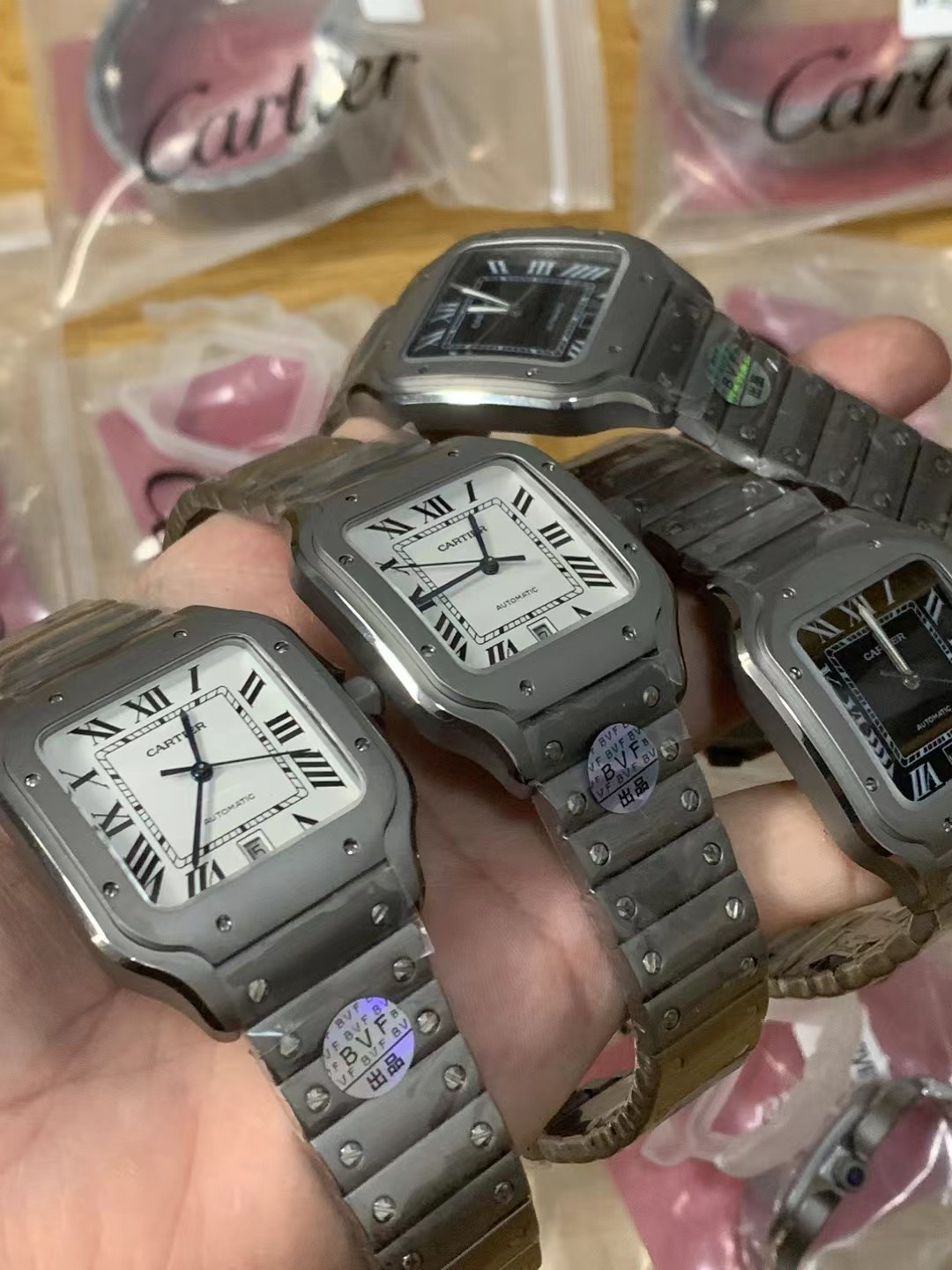
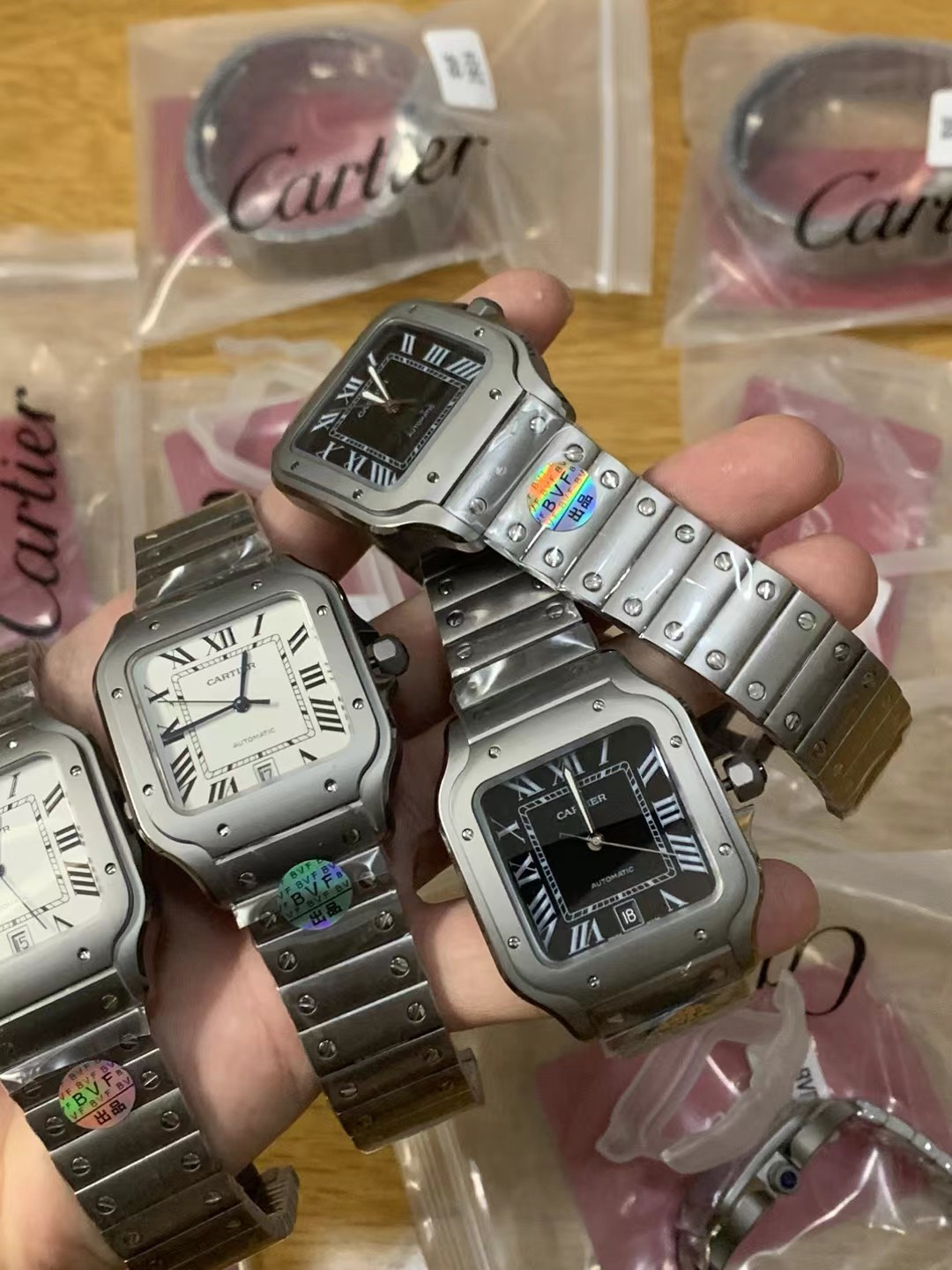
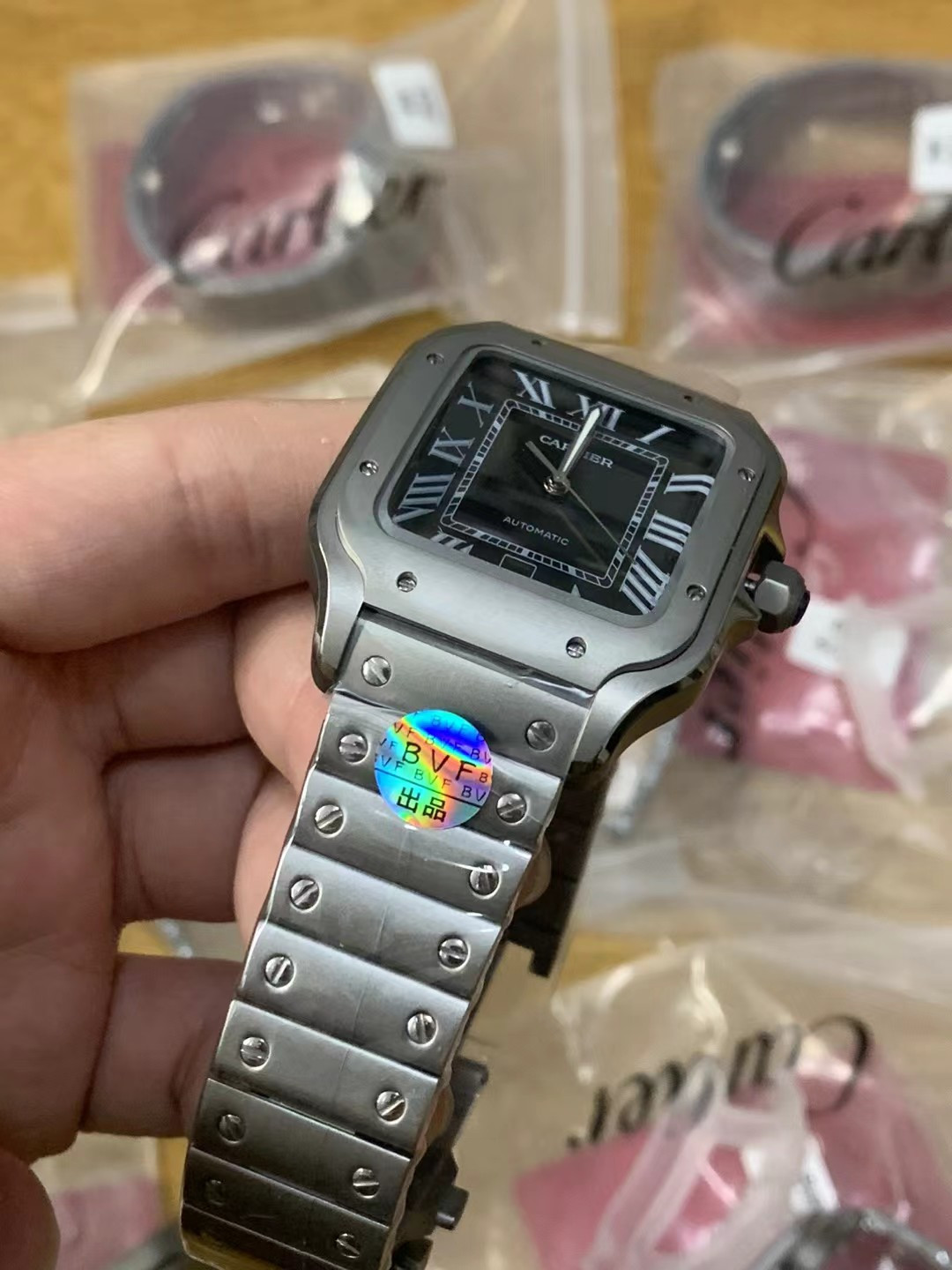
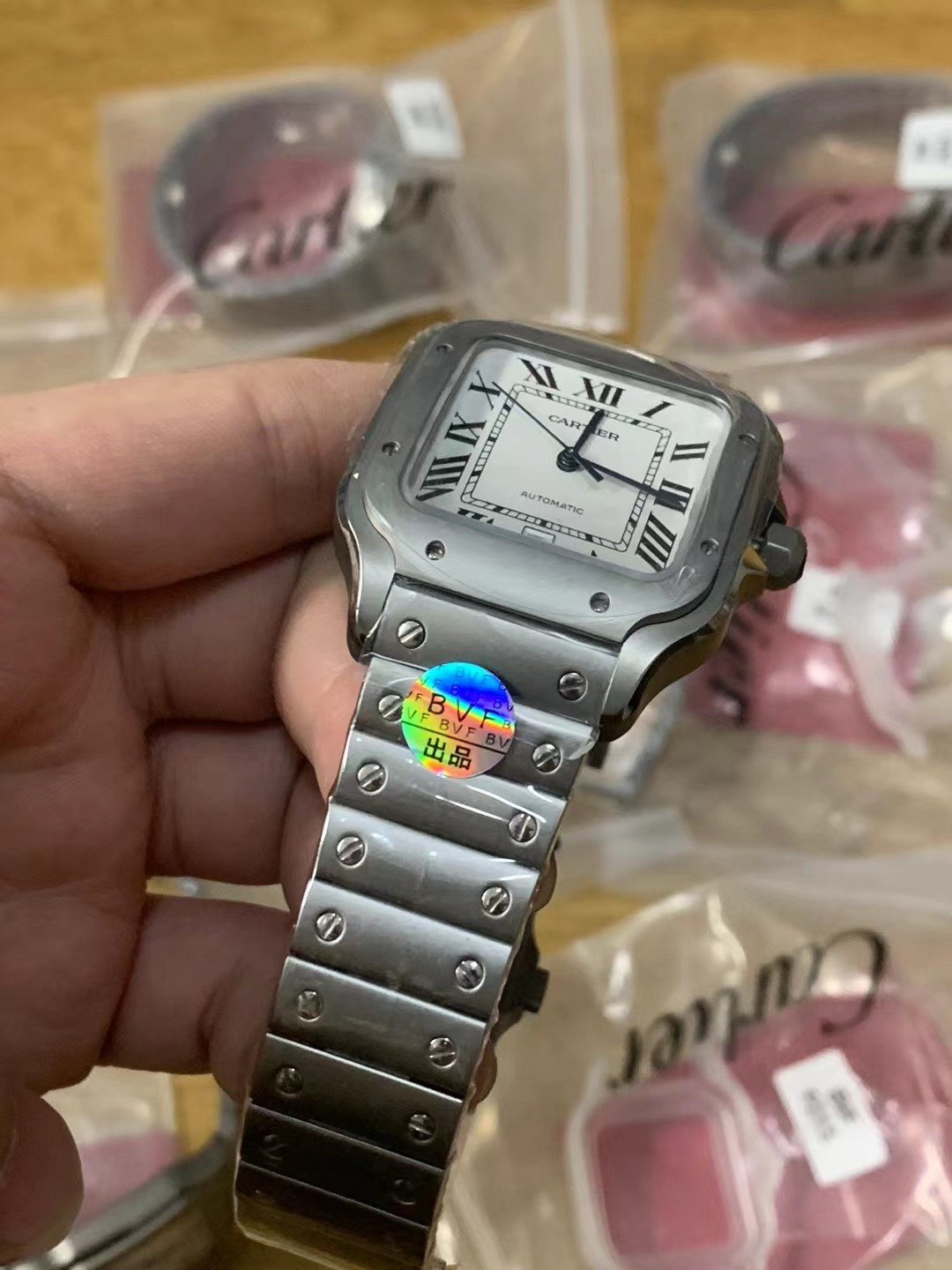
There’s a version of the Cartier Santos that lives in boardrooms and on the wrists of bankers who want to signal taste without screaming money. That version has polished bevels, satin-brushed flanks, and a certain bourgeois softness to it. Then there’s this — the BVF titanium Santos, white dial, matte everything, and a posture that says it has absolutely no interest in impressing you at a dinner party. It wants to go to work. That shift in character, from dressy-sporty hybrid to genuine tool watch, is not cosmetic. It’s philosophical. And the grey market just noticed.
BVF dropping this as a flagship release matters because it signals where serious clone producers are heading. Not chasing the same polished stainless references everyone else is running, but actually tracking Cartier’s own material experiments. The Geneva house has been pushing titanium and ceramic into the Santos line with increasing seriousness, and BVF has responded with a reference-grade attempt that deserves a proper dissection rather than the usual five-sentence forum post.
The Horological Context & Market Reality
Let’s be direct about something the replica community often glosses over: titanium is hard to fake convincingly. Not because it’s visually exotic — it isn’t, it’s grey — but because its tactile and acoustic properties are so distinct. Titanium sits on the wrist with a near-weightless quality that stainless steel simply cannot replicate. It has a dull, almost ceramic-adjacent ring when tapped. It warms to body temperature faster. These are the things a loupe can’t tell you; only your wrist can. So the first and most important question with any titanium clone isn’t how it looks in macro photographs. It’s whether BVF sourced actual Grade 5 titanium alloy or handed us a sandblasted steel case with a titanium-adjacent finish. Based on the weight reports coming in from early recipients — and cross-referencing against the known 47g dry weight of the genuine Santos Large in titanium — BVF appears to have used real titanium here. That alone separates this from 90% of what’s out there.
A sandblasted steel case wearing titanium’s aesthetic is a costume. A genuine titanium case with honest finishing is an argument. BVF is making an argument with this release.
The market context is also worth framing. The authentic Cartier Santos in titanium retails north of $8,000 USD depending on configuration, and Cartier’s AD allocation for this material variant is tight. That creates genuine demand in the grey and replica tiers from collectors who want the experience of the reference without the boutique waiting game or the price. BVF is fishing in a very real pond here.
Case Architecture & Ergonomic Drape
The Santos case architecture is one of the most recognizable in watchmaking — the exposed screws on the bezel, the integrated bracelet with its own screw motif, the octagonal crown. None of that changes in titanium. What changes is everything about how the surfaces catch and reject light.
On the genuine titanium Santos, Cartier made a decisive call: dramatically reduce the polished surfaces and let matte sandblasted finishing dominate. The result is a case that looks almost industrial. The BVF clone follows this faithfully. The bezel flanks are matte. The lug faces are matte. The case band is matte. The only polish you get is on the edges of the bezel screws themselves and a thin chamfer running along the case’s sharpest transitions — and even those are subtle, almost reluctant. This is correct. This matches the genuine reference’s intent.
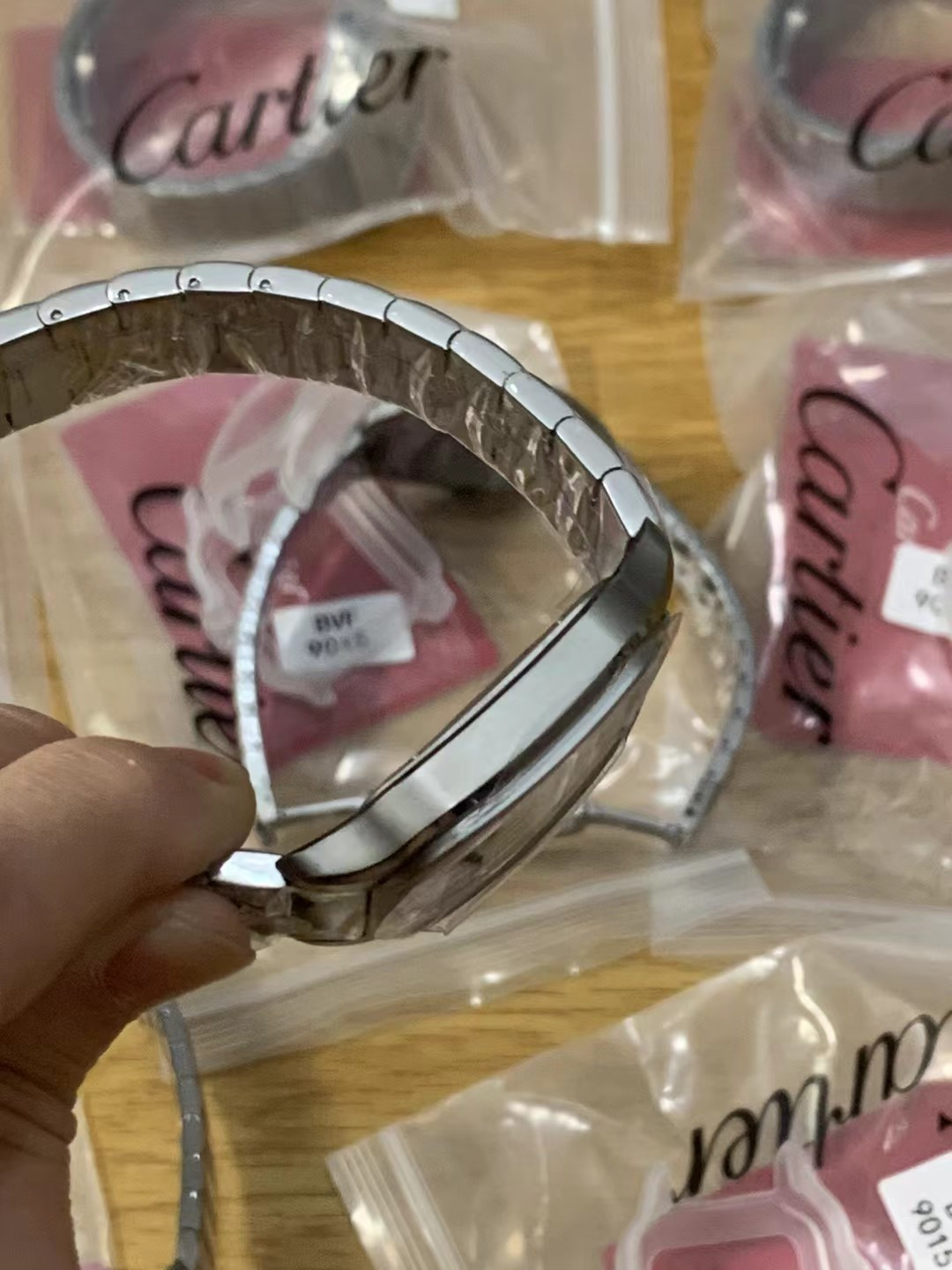
Lug-to-lug on the large Santos sits at approximately 47.5mm, and the BVF clone lands within half a millimeter of that by most measurements. The integrated bracelet — which is the Santos’s most engineering-intensive feature — shows solid SEL articulation. The solid end links sit flush against the case without the micro-gap that plagues cheaper Santos clones where the integration looks more like a suggestion than a structural reality. The deployant clasp operates with a satisfying, if not quite Cartier-grade, resistance. The AR coating on the sapphire crystal shows a clean blue-green bloom in raking light, consistent with multi-layer treatment. No cheap purple single-coat nonsense here.
Ergonomically, this wears well. The Santos, even in large configuration, has a relatively low case height for its footprint, which means it clears shirt cuffs with less drama than the geometry suggests it should. The titanium weight reduction makes this even more wrist-friendly than the steel variant.
The Macro Dial Examination
White dials are brutal. They hide nothing. Every pad-printing inconsistency, every slightly drunk index, every kerning crime is exposed under a 10x loupe with nowhere to hide. So let’s go there.
The BVF Santos white dial uses what appears to be a lacquered white base — not enamel, not Grand Feu, not even close, but that was never the claim. The surface has a clean, even opacity without the orange-peel texture that kills cheaper white dials. Under the loupe, the “CARTIER” text at 12 o’clock shows consistent stroke weight and acceptable kerning. The “SANTOS” designation below it is slightly tighter in letter spacing than the genuine reference, but you need a loupe and a genuine Santos side-by-side to catch it. Naked eye? Clean.
The Roman numeral indices are applied — not printed — and this is where BVF earns real credit. The genuine Santos uses applied Roman numerals with a polished face and a slight three-dimensionality that printed indices simply cannot reproduce. BVF’s applied numerals show consistent height and clean adhesion. The lume fill within the numerals — because yes, the Santos does have lume in its indices — is even and bubble-free under magnification. Hand-stack clearance between the blued steel hands and the dial surface is adequate, no drag risk evident.
The typography on a Santos dial is not decorative. It’s structural to the watch’s identity. Get the Roman numerals wrong and you’ve built a prop. BVF got them close enough to matter.
The blued hands themselves are the dial’s strongest visual element. That deep, rich Cartier blue — achieved on the genuine through a heat-bluing process — is replicated here through a coating process. Under strong directional light, the coating reads as slightly more uniform and less depth-layered than true heat bluing, which has a natural variation to its color gradient. This is a known limitation of clone production and not a BVF-specific failure. It’s an industry ceiling, not a floor.
Movement Analysis & The Tell
BVF has fitted this Santos with the Miyota 9015 caliber, which they’re calling their “flagship” movement for this reference. Let’s be precise about what the 9015 is and isn’t. It’s a 28,800 vph (4Hz) automatic with a quick-set date, 42-hour power reserve, and a reasonably robust construction that has proven itself over years of deployment in the grey market. It is not a Cartier Calibre 1847 MC. It is not a COSC-certified movement. But it runs, it hacks, it winds bidirectionally, and it keeps time within acceptable daily variation for a working tool watch.
Through the exhibition caseback — and BVF has correctly included one here, matching the genuine Santos’s caseback design — the 9015 rotor shows Côtes de Genève decoration on the rotor plate and basic perlage on the mainplate. The finishing is competent rather than impressive. The balance wheel oscillates with good visual amplitude at full wind. Escapement action looks nominal.
The tell? It’s the rotor weight. The 9015’s rotor is slightly heavier and swings with more inertia than the slim, architecturally considered rotor on the genuine Cartier movement. Through the caseback glass, side by side with a genuine Santos, you’d notice the rotor’s different visual mass. On its own? Most people won’t register it. But if you know Cartier movements, you know. The rotor is the fingerprint that gives it away to anyone who’s spent real time with the authentic caliber.
Overall Verdict
BVF has produced something genuinely interesting with this titanium Santos. The case material appears authentic, the finishing philosophy matches Cartier’s own matte-forward direction for this variant, the dial work is among the cleaner white dial executions in this tier, and the 9015 is a reliable if unromantic engine. This isn’t a watch that will fool a Cartier watchmaker. It will, however, sit on your wrist with the right weight, the right visual presence, and the right tool-watch attitude that the genuine titanium Santos is designed to project.
At the price point BVF is asking for a titanium-cased, exhibition-back, applied-index Santos clone running a 9015, the value proposition is unusually strong. The grey market has seen plenty of Santos clones. This one is asking a different question — not “can we copy the shape” but “can we copy the material intent.” The answer, mostly, is yes.
Whether that’s enough for you depends entirely on why you’re looking at clones in the first place.