There are watches you review, and then there are watches that review you — objects so architecturally demanding that they force you to confront the limits of your own attention to detail. The Audemars Piguet Royal Oak 26240 in full ceramic belongs firmly to the second category. Even in its authentic form, this is a watch that has humbled manufacturers and finishing houses alike; the geometry is unforgiving, the material is punishing, and the visual language is so precisely codified that even a fraction of a millimeter’s deviation reads as failure. So when a replica house claims to have cracked it — truly cracked it, in high-density ceramic, at 1:1 fidelity, down to a weight-matched rotor and a titanium caseback — the only reasonable response is to put it on your wrist and let the light do the cross-examination.
The Allure of the Impossible Material
Ceramic is the great equalizer in high-end watchmaking, a material that rewards no shortcuts and forgives no laziness. It cannot be filed, buffed back into shape, or corrected after the fact. The geometry must be right the first time, every time, because the finished surface is essentially permanent. This is precisely why the Royal Oak 26240’s ceramic execution has always been considered among the most technically daunting in the entire replica market — and it is precisely why sliding this particular piece out of its presentation box produces a small, involuntary intake of breath. The case arrives at 147 grams, a figure that matches the genuine article’s heft with an exactitude that feels almost confrontational. You do not simply wear this watch; you feel it settle onto the wrist with a quiet authority, the cool density of the ceramic pressing against the skin like a firm handshake from someone who knows exactly how strong they are.
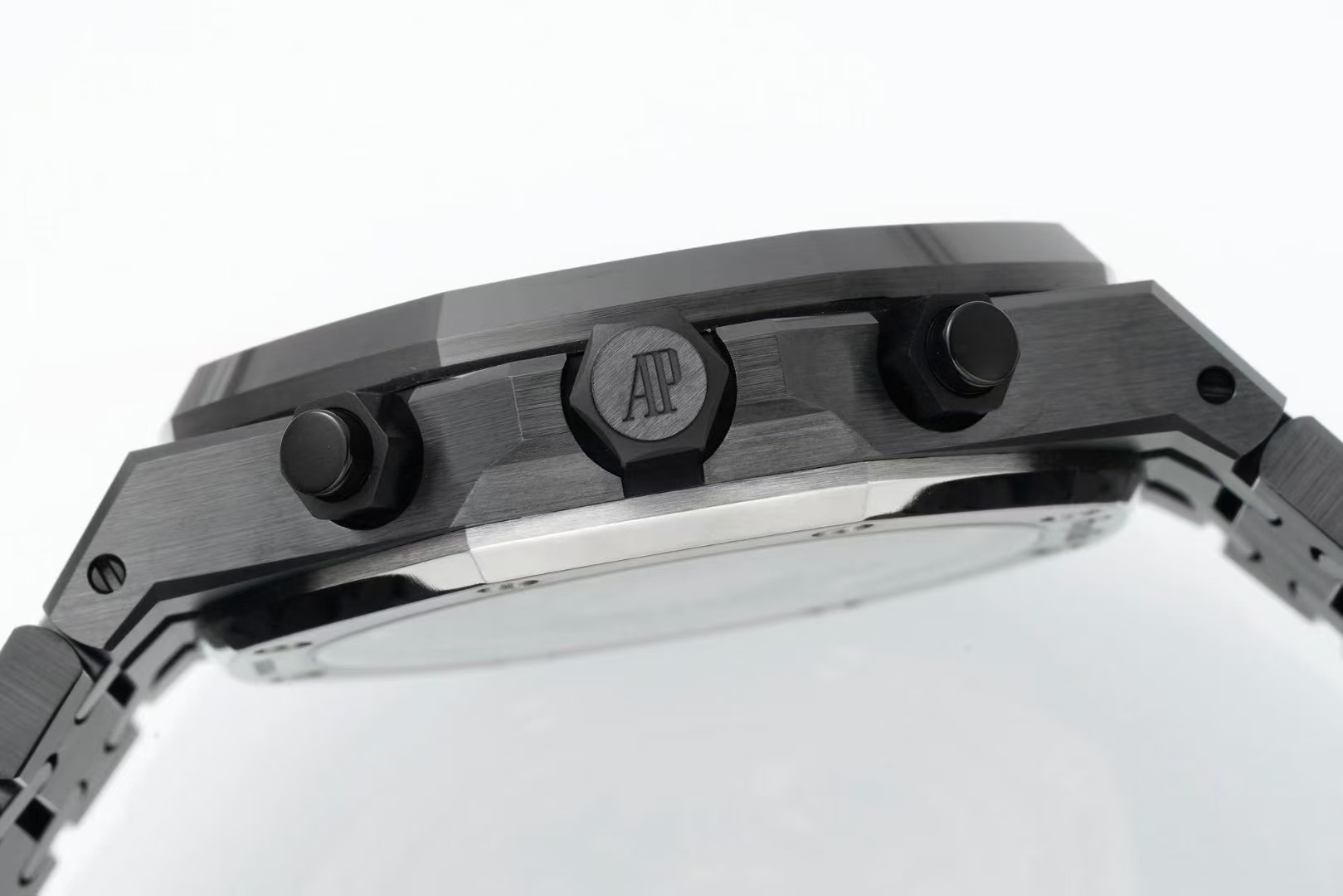
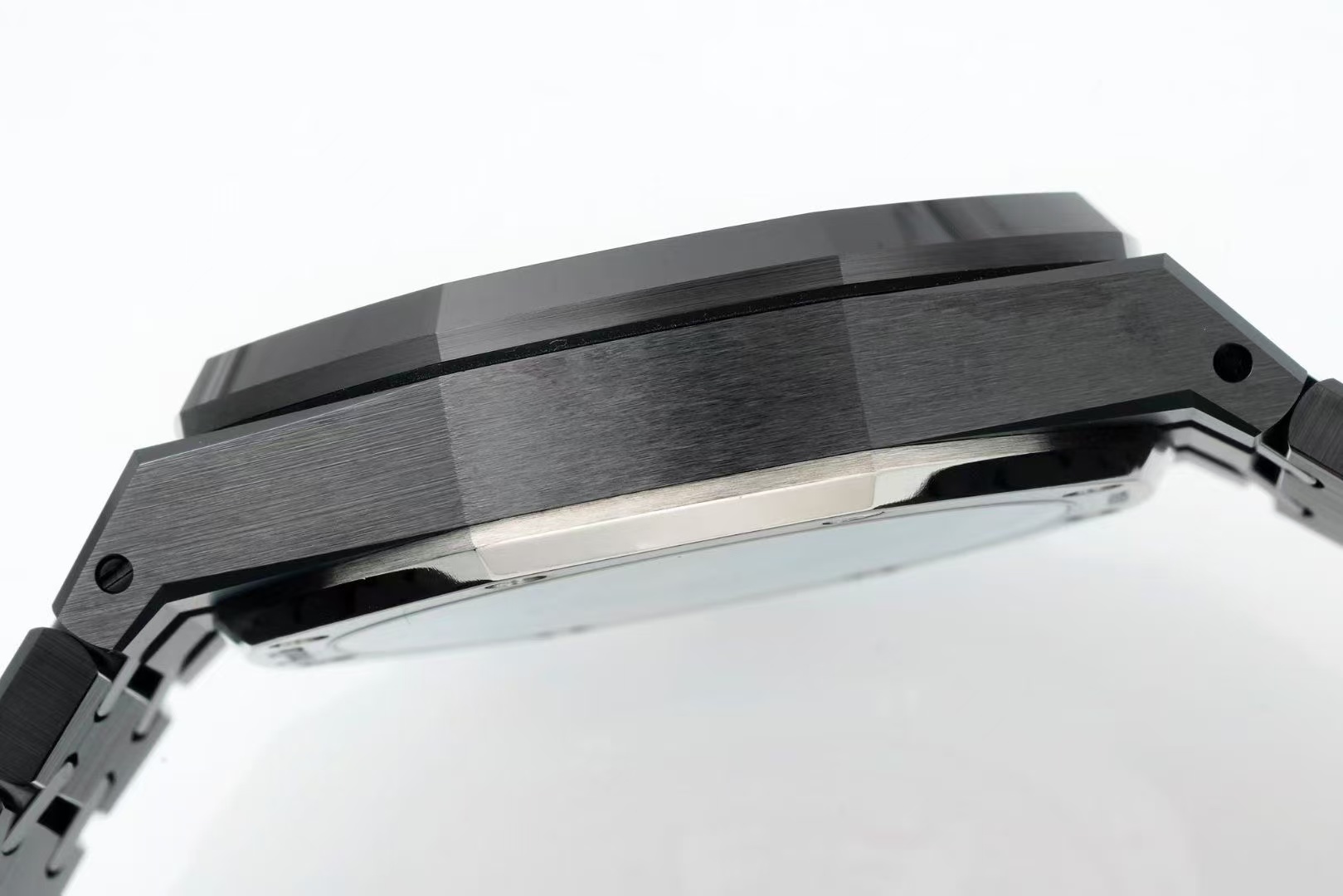
The color is deep, absorbing, and completely consistent across every surface — no patchiness, no tonal variation where the satin-brushed sections transition into the polished chamfers. That transition, incidentally, is where ceramic replicas most commonly collapse into mediocrity, and it is where this piece most visibly earns its reputation. The brushed flanks of the octagonal bezel flow into the polished edges with a crispness that catches the light in a single, clean line rather than the blurred, rounded compromise you find on lesser executions.
Architecture in Ceramic: The Case and Its Geometry
The Royal Oak’s DNA is entirely geometric — it lives and dies by its angles, and the 26240’s eight-sided bezel is the load-bearing wall of the entire design. Each of the six hexagonal screw recesses is machined with a three-dimensional depth that gives each fastener its own small stage; the imported high-polish screws sit flush and luminous within their countersunk seats, catching light independently from the surrounding brushed ceramic in a way that reads as deliberate punctuation rather than functional hardware. Run a fingernail along the bezel-to-case junction and you find no gap, no play, no perceptible ridge — the fit is absolute.
The case itself continues the Royal Oak’s signature dialogue between satin-brushed and mirror-polished surfaces, and the execution here is particularly strong in the areas that replica manufacturers most commonly neglect: the concave inner curves between the lugs, the so-called pig-snout recesses where the case transitions beneath the bracelet attachment points. These dead-angle zones, invisible in product photography but immediately obvious in hand, carry satin-brushed linework that runs perfectly parallel and consistent in both texture and direction, with no coarsening or interruption at the edges. The octagonal case-to-bezel junction lines are bold, continuous, and dimensionally sharp — the kind of detail that, on the genuine watch, requires ceramic grinding tooling of extraordinary precision, and which here is reproduced with a fidelity that will make you look twice, then look again.
The solid end links where the bracelet meets the case are executed with the same high-density ceramic as the case body, and the bracelet itself — molded from the original tooling — drapes with a suppleness that is genuinely surprising for a ceramic construction. The inner surfaces are smooth against the wrist hair, the links articulating without stiffness or lateral play, and the polished and brushed surfaces on each link run straight and true, the edges clean enough to cast their own tiny shadow lines in raking light. The deployant clasp and caseback are rendered in Grade 5 titanium, matching the original’s specification with a material choice that adds both corrosion resistance and a subtly warmer tone to the underside of the watch.
Beneath the Crystal: The Dial as Textile
If the case is the watch’s architecture, the dial is its fabric, and the Royal Oak’s Grande Tapisserie pattern is one of the most recognizable textiles in all of horology. The challenge of reproducing it faithfully lies not just in the grid’s regularity but in its dimensionality — each small square must be raised, its edges crisp, its surface catching light at a slightly different angle from its neighbor, so that the entire dial shimmers and shifts as the wrist moves. The pattern here is enlarged and rendered with a three-dimensional relief that is immediately perceptible both to the eye and, faintly, to the fingertip through the AR-coated sapphire crystal. The grid is uniform in spacing, consistent in depth, and the radiating texture that underlies the whole composition is visible and assertive rather than washed out.
The applied indices sit proud of the dial surface with a solidity that speaks to proper construction, and the lume fill within each marker is even and bubble-free, glowing with a cool consistency after dark. The date aperture at three o’clock is laser-engraved with a four-axis precision that gives its edges a three-dimensional squareness entirely absent from the soft, printed windows you find on budget executions — the aperture frame casts a genuine shadow, the numeral within it appearing to float at a slightly different depth from the dial plane. The hand-stack — hours, minutes, and seconds — carries the correct proportions and lume application, and the AP logo at twelve o’clock is engraved rather than printed, each letter dimensionally correct, the characteristic long-legged ‘A’ and the angled middle stroke of the ‘E’ reproduced with the kind of typographic fidelity that only engraving can achieve. The Royal Oak wordmark below is equally precise, the characters sitting with an evenness of depth and spacing that holds up under loupe scrutiny.
The Engine Room: The Caliber 4401 and Its Execution
The movement powering this watch is the in-house Dandong-manufactured caliber 4401, running at a slim 6.8mm in overall thickness — a figure that allows the case profile to maintain the correct proportions rather than ballooning into the tell-tale thickness that betrays so many otherwise competent replicas. The free-sprung balance wheel, operating without a traditional regulator index, provides a stability and accuracy advantage over conventional regulation systems, the escapement running with a smoothness that translates into a sweep of the seconds hand that is fluid rather than mechanical-feeling.
The rotor weight has been matched to the original’s specification, and the practical consequence of this is immediately apparent: the winding response is brisk and authoritative, the mainspring tensioning readily with normal wrist movement rather than requiring extended periods of activity to build reserve. Through the caseback — that same Grade 5 titanium construction — the rotor carries the AP lettering in a rounded, well-proportioned typeface that matches the original’s engraving character, and all external components are confirmed interchangeable with genuine parts, a standard of dimensional accuracy that speaks to the seriousness of the tooling investment behind this piece.
The Final Verdict: A Ceramic Argument Worth Having
Replica watches occupy a complicated space in the broader conversation about horology, but within that space, ambition varies enormously — from the purely cosmetic to the genuinely obsessive. This 26240 ceramic sits at the obsessive end of that spectrum. The material choice alone is a statement of intent: high-density ceramic is not a forgiving medium, and choosing it for a 1:1 replica of arguably the most geometrically demanding watch in the Royal Oak family is either hubris or confidence, and the finished object makes a compelling case for the latter. The weight is right, the angles are right, the finishing transitions are right, and the movement inside it earns its place with genuine mechanical credentials rather than merely adequate ones.
Is it the genuine article? No — and no serious person would claim otherwise. But as an exercise in understanding what makes the Royal Oak 26240 so visually and tactilely compelling, as a study in ceramic geometry and surface finishing, and as a wearable object that carries the essential character of one of watchmaking’s great designs, it is a remarkably honest piece of work. The rehaut is clean, the crown threads with precision, and every time the light catches those bezel chamfers and throws that single, perfect line of reflection across the room, you are reminded that some designs are so good that even the most demanding reproduction of them is, in its own right, worth paying close attention to.