Few watches in the modern canon carry the cultural and aesthetic weight of the Audemars Piguet Royal Oak. Since Gérald Genta sketched its octagonal bezel and integrated bracelet on a single sheet of paper in 1972, the Royal Oak has occupied a space that no other timepiece quite manages — simultaneously industrial and refined, sporty yet unambiguously luxurious. The 26574ST, with its grand complication dial presenting calendar, day, month, and moon phase functions within that iconic 41mm case, represents one of the collection’s most technically ambitious expressions. It is precisely this combination of horological substance and visual authority that makes it such a compelling subject for a high-grade replica. The question, as always, is not whether the ambition is there — it clearly is — but how faithfully that ambition translates into the physical object you hold in your hand.
Architecture in Steel
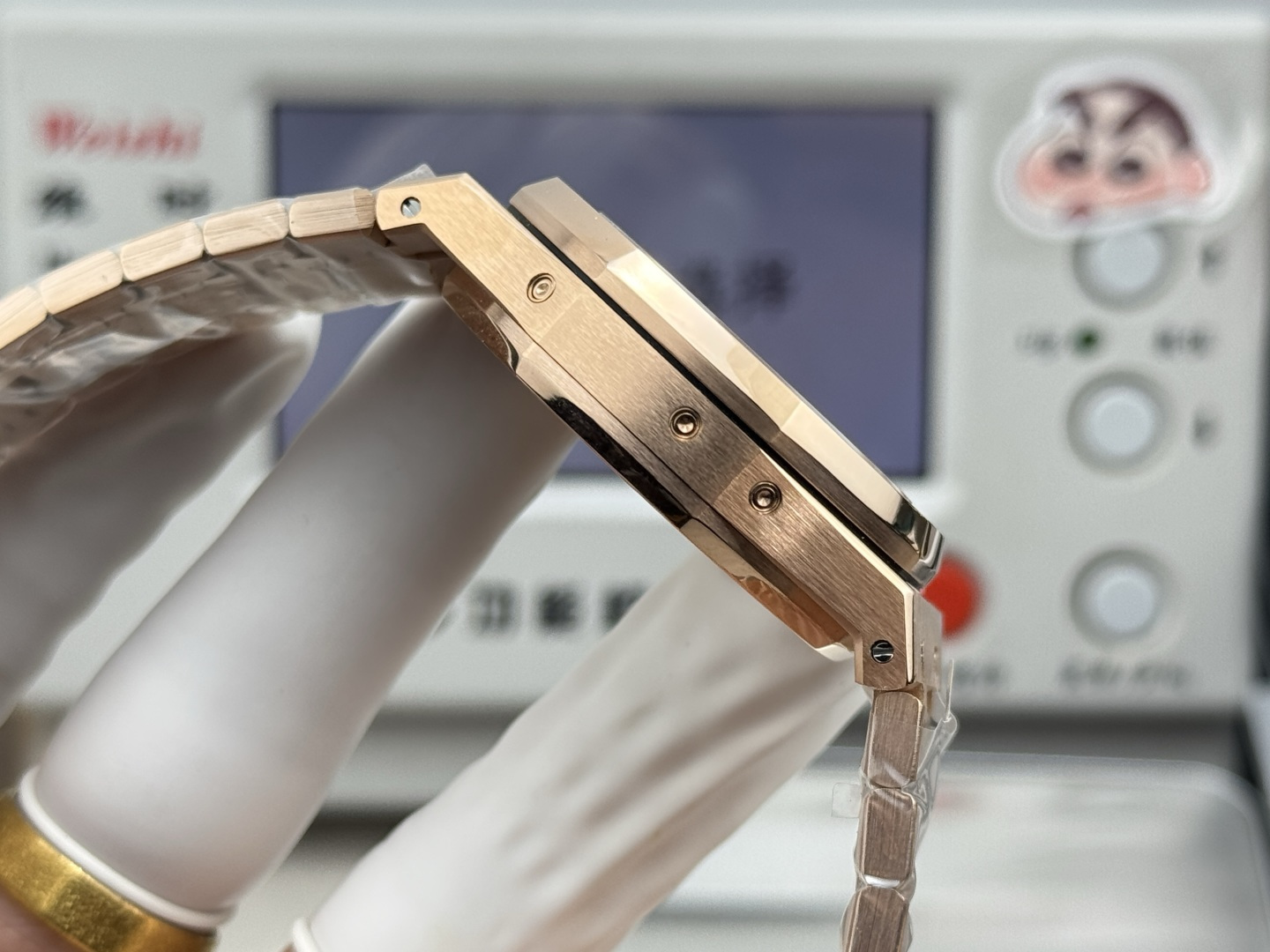
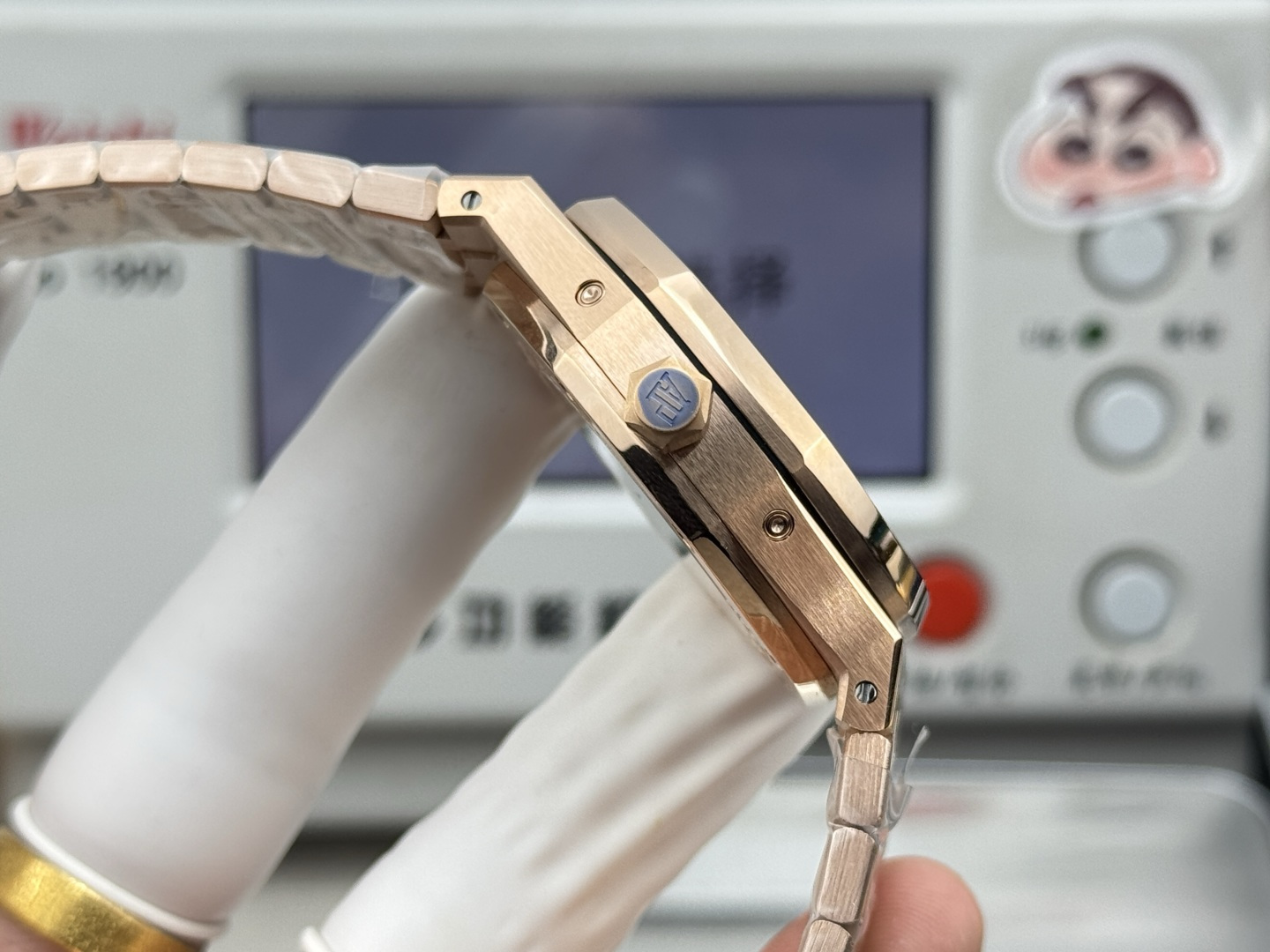
At 41mm, the case occupies the wrist with exactly the confident presence you would expect from a Royal Oak of this reference. The 316L stainless steel construction is the first thing worth examining seriously, because on this replica the CNC machining is genuinely impressive. The case density feels immediate and purposeful — there is none of the hollow, slightly tinny quality that betrays lesser clones the moment you pick them up. The steel has been worked with a precision that closely mirrors the genuine article’s characteristic interplay of surfaces: satin-brushed flanks meeting polished chamfers with clean, deliberate transitions.
That interplay of finishing is, of course, central to the Royal Oak’s entire visual identity. The octagonal bezel, secured by its eight signature hex screws, carries a satin-brushed top surface that catches directional light in a flat, matte wash, while the polished bevels along its edges catch and throw light with far more drama. This contrast — what watchmakers call anglage in its most architectural form — is handled here with commendable consistency. The lines are straight, the angles are repeatable across all eight facets, and there is no visible slurring of the polish into the brushed zones, which is precisely where budget replicas tend to reveal themselves. The case-to-bracelet integration, achieved through solid end links, is tight and flush, with no perceptible gap or wobble at the lugs — a detail that matters enormously to the overall silhouette when the watch sits on the wrist.
The crown, positioned at three o’clock in the Royal Oak’s characteristic recessed fashion, operates with reasonable smoothness across its positions, and the case back closes with a satisfying resistance. Three distinct components — the bezel ring, the mid-case, and the case back — are assembled here as a proper three-piece construction, which contributes both to the structural integrity and to the dimensional accuracy of the profile when viewed from the side.
The Dial Landscape
The dial of the 26574ST is where the Royal Oak’s visual complexity becomes most apparent, and where a replica either earns its reputation or quietly surrenders it. This example presents the characteristic Grande Tapisserie pattern — the finely checkered guilloché texture that covers the dial’s primary surface — with a consistency and depth that reads convincingly under varied lighting conditions. The pattern is crisp at the centre and maintains that crispness toward the edges, which is a meaningful achievement given how easily this particular texture can appear flat or slightly blurred in reproduction.
The applied indices are cleanly executed, sitting level against the dial surface without the slight tilt or adhesive bleed that can undermine an otherwise strong dial. The typography across the subsidiary registers — day, date, month, and moon phase — follows the original’s layout with fidelity, and the pad-printing on the smaller text elements is sharp enough to read cleanly without a loupe. The moon phase aperture at six o’clock is particularly worth noting: the disc beneath presents a deep blue field with a reasonably well-rendered lunar disc, and while it lacks the fine guillochage of the genuine component, it holds up admirably at normal viewing distances.
The Super-LumiNova application on the indices and hands glows with a consistent blue-green tone in darkness, applied evenly enough that no single index appears noticeably brighter or dimmer than its neighbours. The sapphire crystal overhead carries a subtle AR coating tint — the faint blue-green bloom visible at oblique angles — which does a creditable job of reducing surface reflections and allowing the dial’s texture to remain legible across a range of lighting environments. The rehaut, that narrow inner ring between the crystal and the dial edge, carries the familiar AP branding at twelve o’clock, rendered cleanly and without the soft edges that sometimes betray replica printing at this scale.
Mechanical Reality
Powering this replica is a customised caliber designated as the cal. 5134 — a clone movement engineered to replicate the functional architecture of the genuine AP calibre that drives the 26574ST’s perpetual calendar complications. And here, it is worth being precise about what that means in practice. The day, date, month, and moon phase indications are all live, operational functions, not decorative props frozen in position. They advance correctly, respond to crown adjustments, and track the calendar with the kind of reliable daily accuracy you would expect from a well-regulated clone movement.
What this caliber is not, however, is a Swiss-finished movement of the order found in the genuine timepiece. The rotor bearing will not spin with the same frictionless whisper, and a view through a display case back — were one fitted — would reveal finishing that prioritises function over decoration. The anglage on the bridges, the perlage on the plates, the blued screws: these are either absent or approximated rather than authentically executed. For a replica worn as a daily piece, this is an entirely reasonable trade-off, and the movement’s functional accuracy across all its complications is genuinely the more important metric for most wearers. It runs, it tracks, it keeps reasonable time — and the complications work as advertised.
The Considered Verdict
What this Royal Oak 26574ST replica ultimately offers is a physically convincing interpretation of one of horology’s most recognisable and structurally demanding designs. The case machining is strong, the finishing contrast is handled with more care than the price point might suggest, and the multi-complication dial — with its working calendar, day, month, and moon phase — delivers genuine practical utility rather than mere visual theatre. The clone movement is honest in its limitations but reliable in its functions, and the bracelet, with its solid end links and flush integration, contributes meaningfully to the wearing experience rather than undermining it.
For the collector who understands precisely what they are acquiring — a well-executed facsimile rather than a horological artefact — this piece makes a coherent and considered case for itself. The Royal Oak’s geometry is demanding to replicate well, and this example meets that demand with a seriousness of purpose that is, at this level of the replica market, genuinely worth acknowledging.