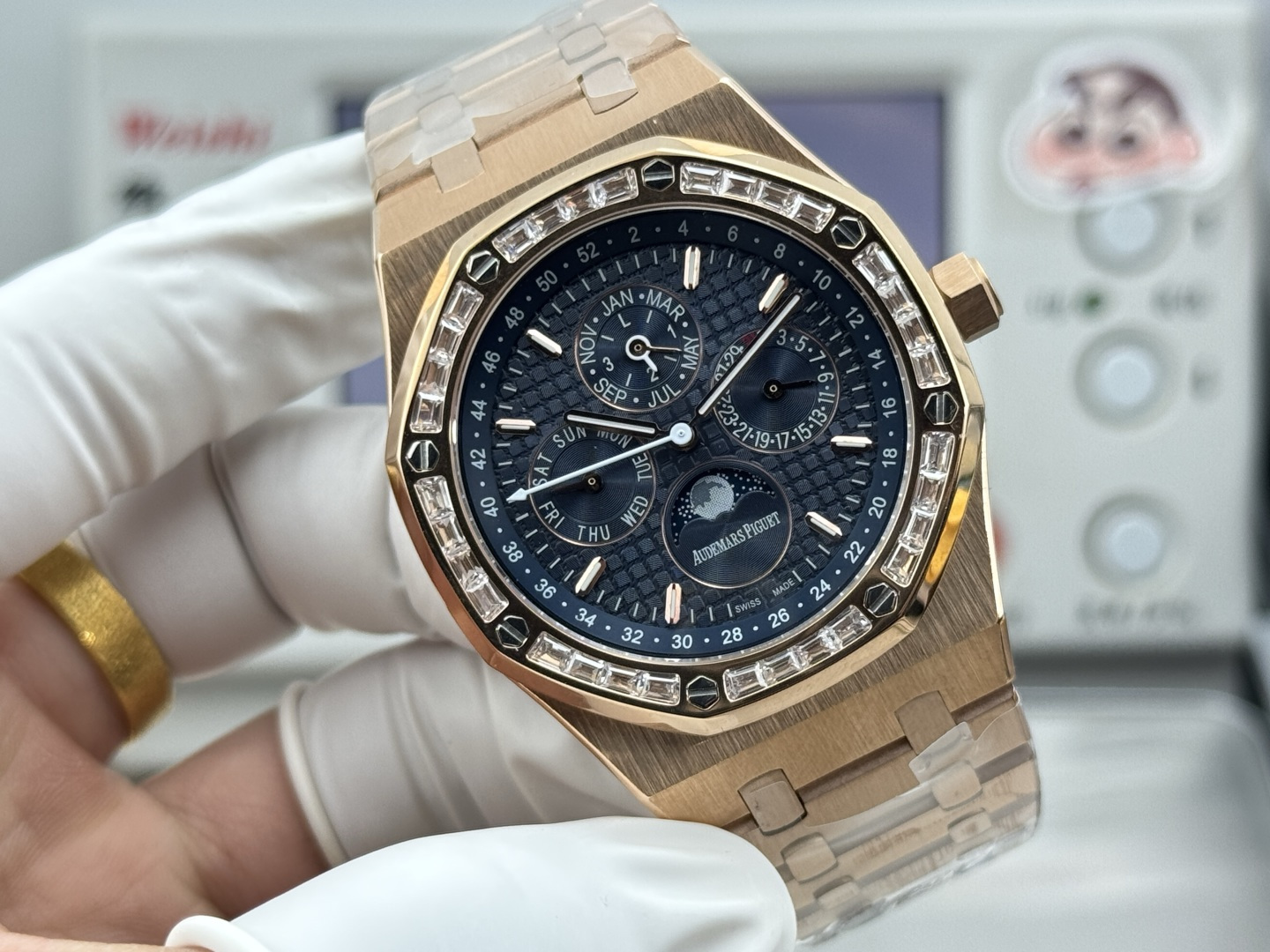
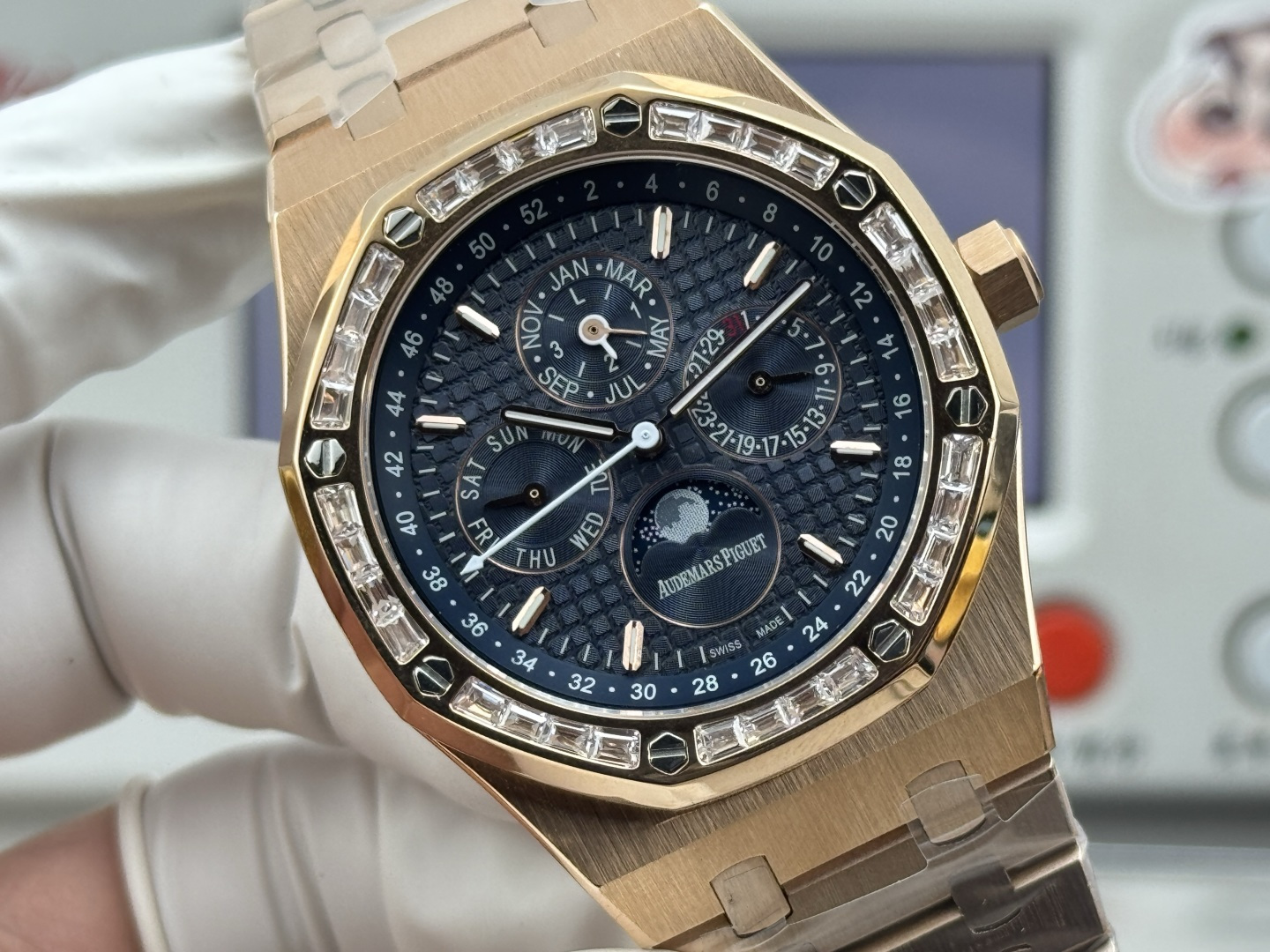
Let me be direct with you. I’ve spent the better part of two decades handling genuine Audemars Piguet pieces, sitting across white-gloved boutique staff who speak in hushed reverent tones about “allocation” and “client relationships.” I’ve watched the Royal Oak Perpetual Calendar — reference 26574ST specifically — become one of the most aggressively gatekept complications in modern haute horlogerie. And I’ve watched otherwise rational adults prostrate themselves before ADs for the privilege of spending north of thirty-five thousand dollars on a watch they couldn’t even see before signing. So when a 1:1 clone of this exact reference lands on my desk, built around a custom Cal.5134 and 316L stainless steel with CNC finishing, you’ll understand why I approach this with a particular kind of sardonic curiosity.
The Retail Absurdity
The genuine AP 26574ST is, objectively, a stunning piece of engineering. A perpetual calendar — day, date, month, moonphase — crammed into a 41mm Royal Oak case with that iconic integrated bracelet. The authentic movement, Caliber 5134, is a proven workhorse that AP has refined over decades. It beats at 21,600 vph, has a 40-hour power reserve, and features finishing that genuinely justifies some portion of its retail price. Some portion. Not all of it. Because a significant chunk of what you’re paying for at an authorized dealer is access, exclusivity, and the theater of Swiss prestige — none of which has anything to do with the actual object on your wrist.
The waitlist for this reference, depending on your market and your relationship with the boutique, runs anywhere from two to five years. Two to five years. For a watch. Meanwhile, the manufacturer continues producing them, the secondary market continues flipping them at 40% premiums, and the whole ecosystem operates less like fine watchmaking and more like a deliberately engineered scarcity machine. I’m not moralizing here — the market is what it is. But this context matters enormously when evaluating what a competent clone actually represents.
“When the genuine article is priced and distributed more like a speculative asset than a functional timepiece, the replica market stops being a moral failure and starts looking like a rational consumer response.”
First Impressions & The Weight of Steel
The 26574ST clone arrives in a 41mm case, which is correct. The genuine runs 41mm lug-to-lug is actually more like 50mm, and at first handling, this clone sits convincingly on the wrist. The 316L stainless steel is the standard grade you’ll find across the mid-to-high tier of the grey replica market — it’s not the same alloy composition AP uses, which leans toward a proprietary blend with slightly different surface hardness, but it’s entirely serviceable and won’t corrode on you in any normal wearing scenario.
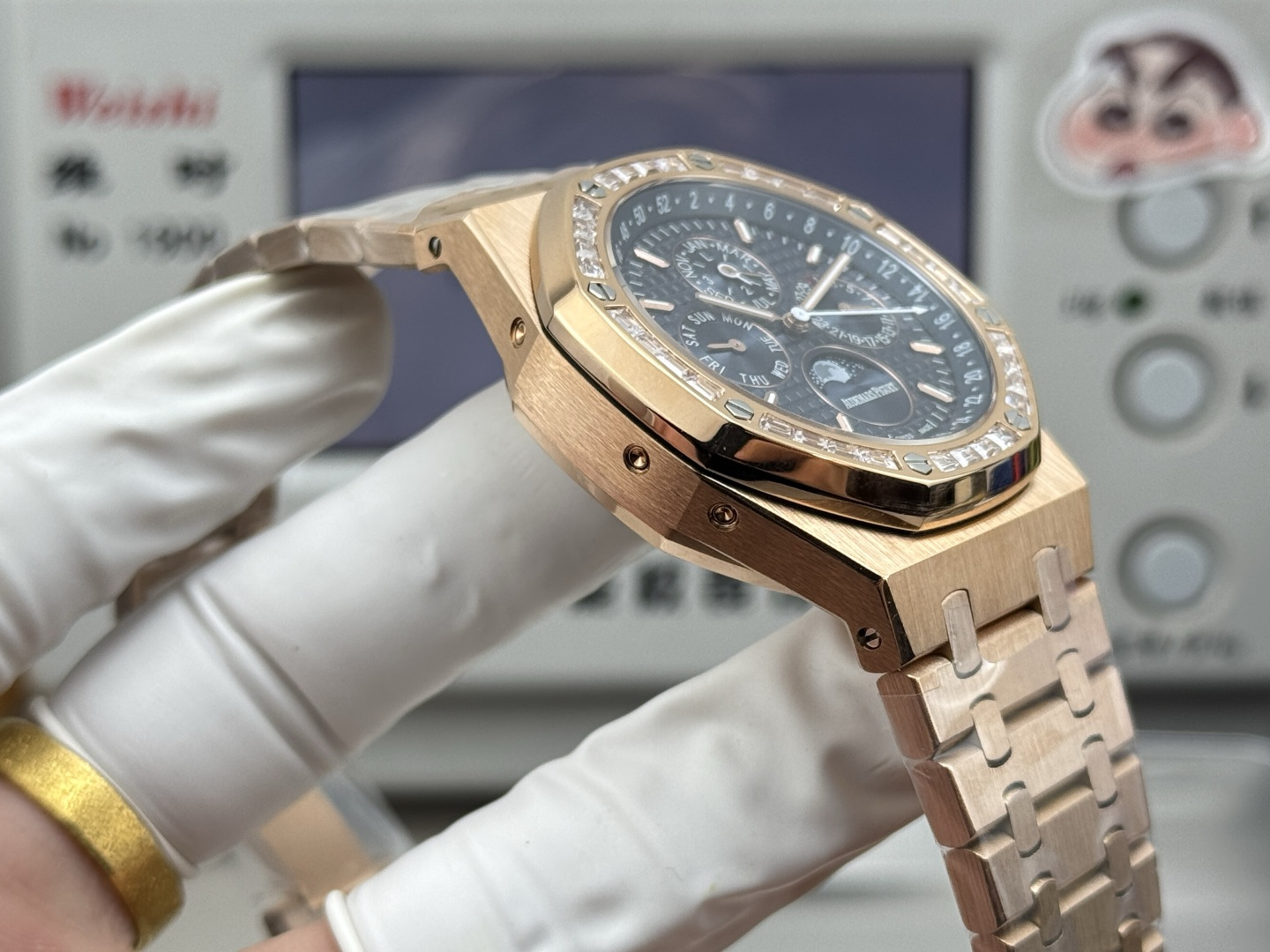
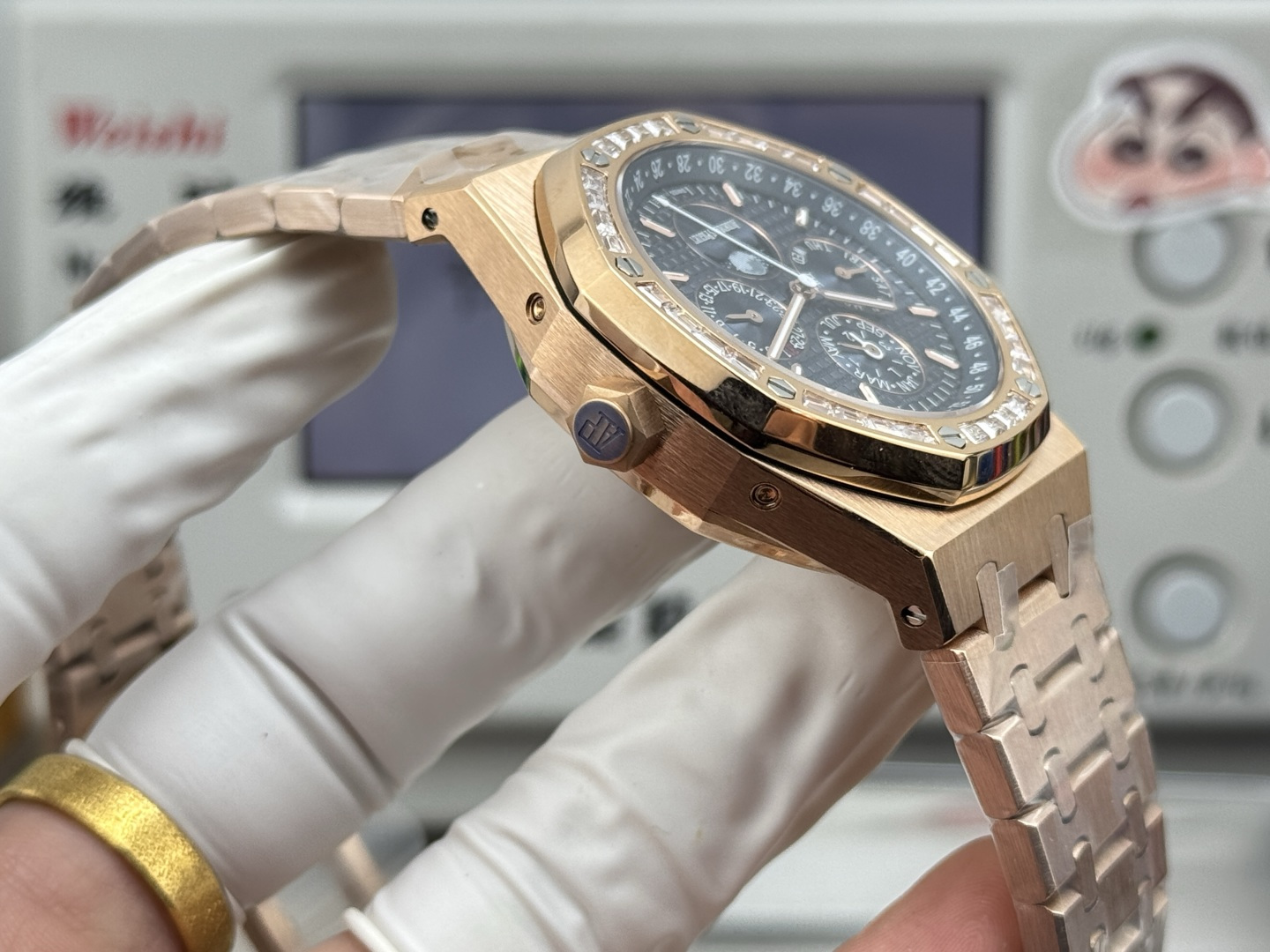
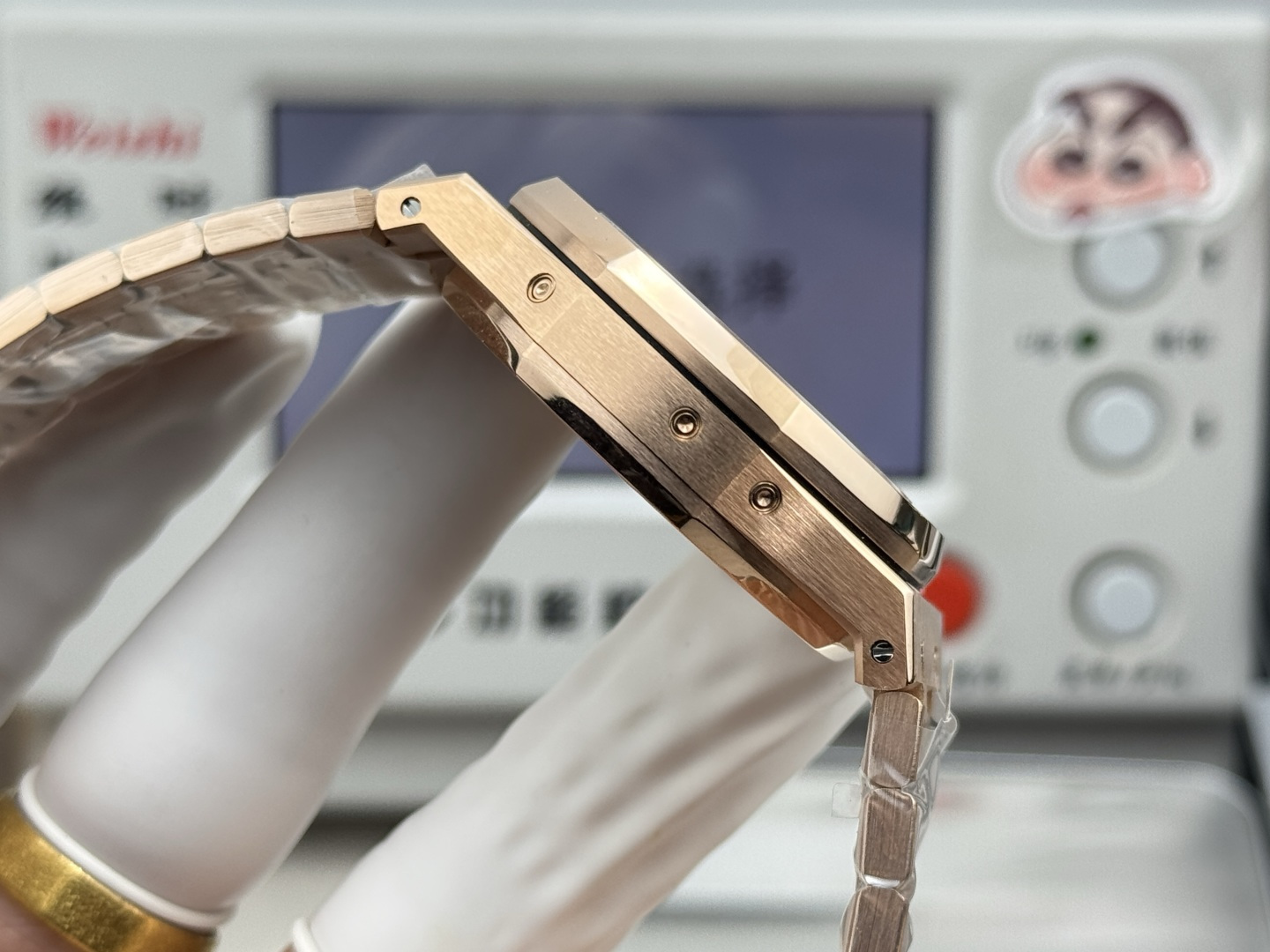
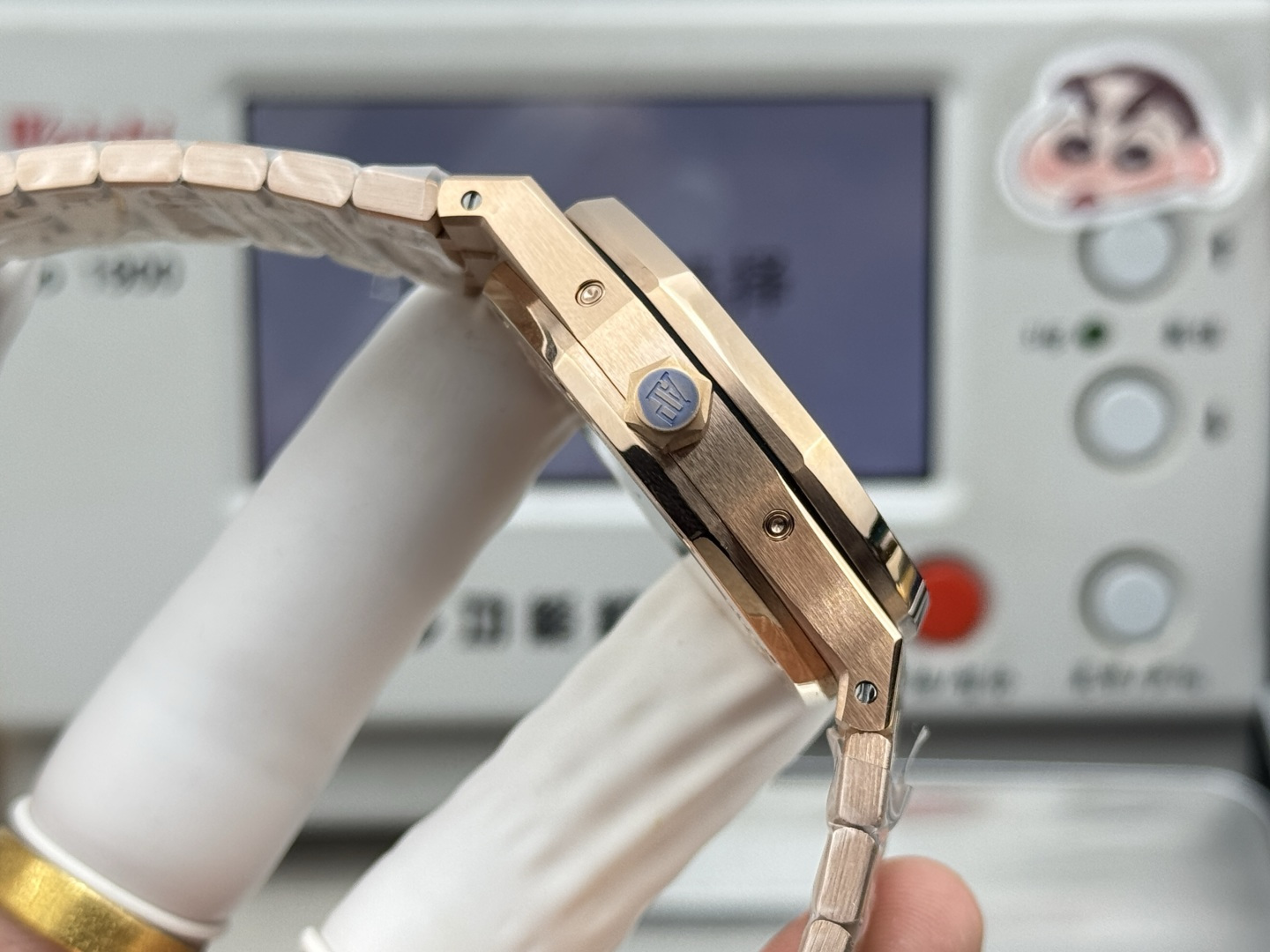
The CNC machining claim is where things get interesting. Pick this case up and rotate it under a strong light source. The alternating brushed and polished surfaces — the satin-brushed flanks of the case body contrasted against the mirror-polished bevels — are the Royal Oak’s defining visual signature. Gérald Genta’s original 1972 design lives and dies on the precision of those surface transitions. On this clone, the transitions are present and they are reasonably clean. Not immaculate. Under a 10x loupe, the chamfering on the case edges shows slight inconsistency — the anglage width varies by roughly half a millimeter in places where the genuine piece maintains almost machine-perfect uniformity. But at arm’s length? At the dinner table? Convincing.
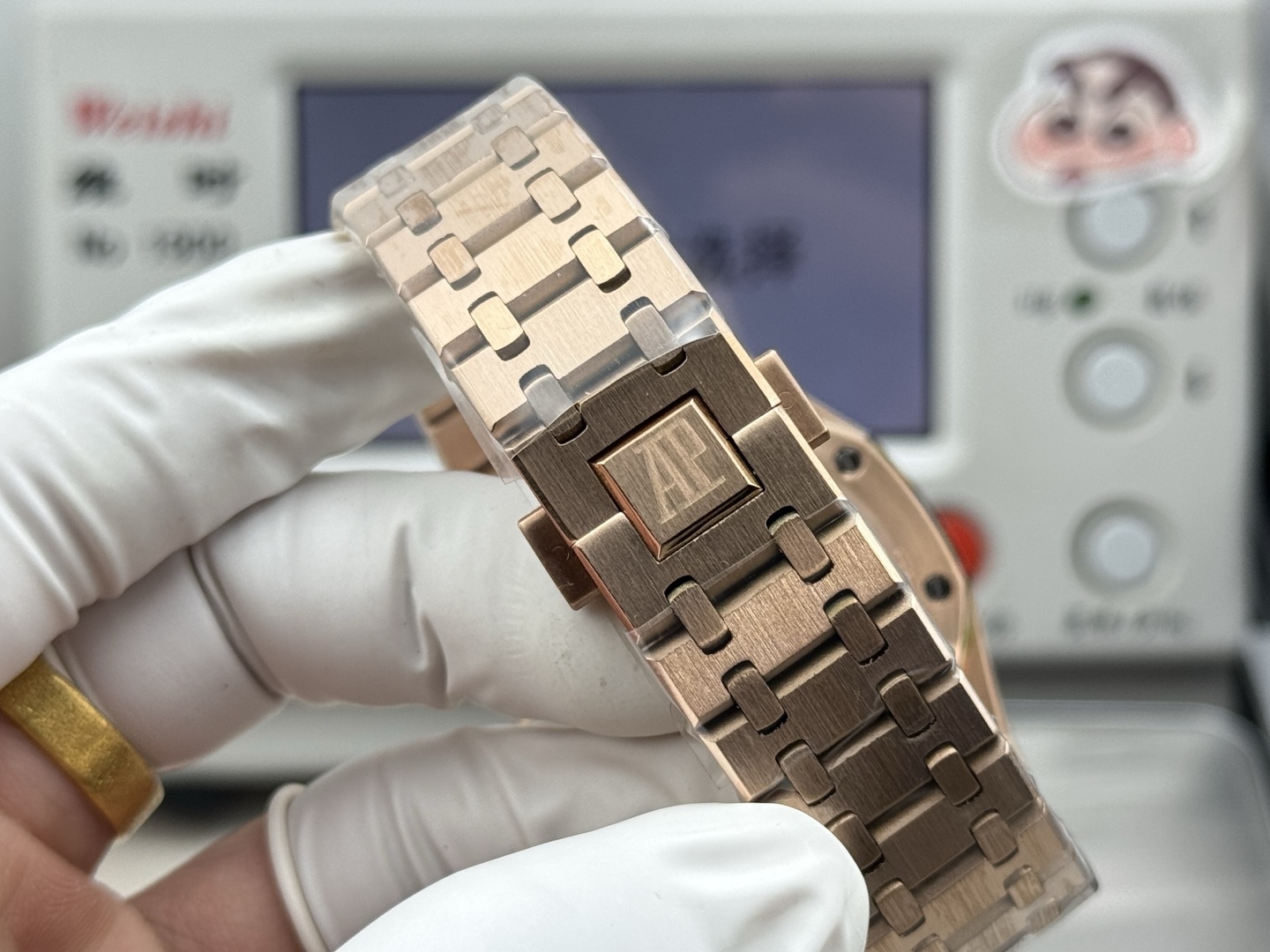
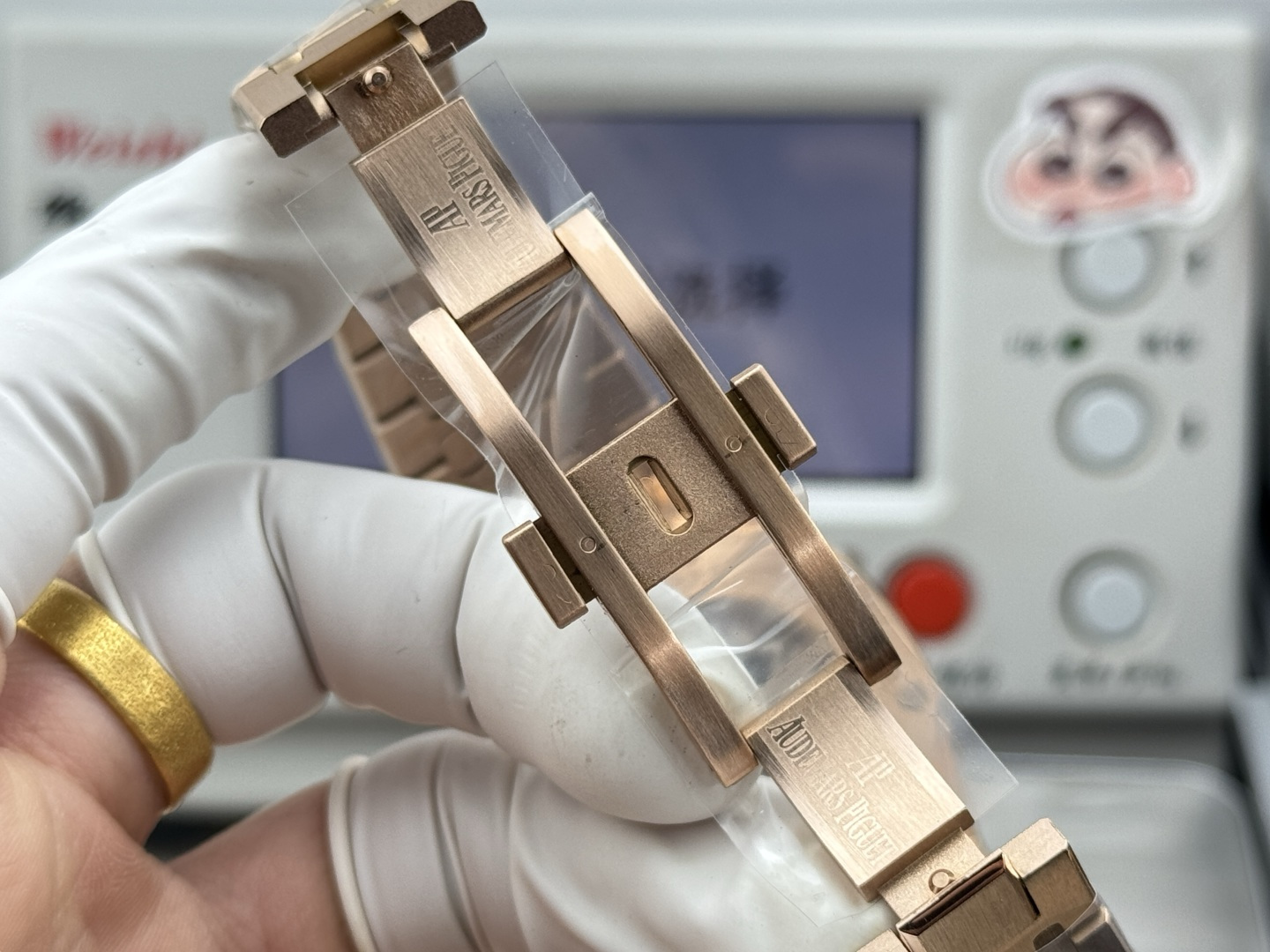
The bezel, with its characteristic exposed hexagonal screws, is one of the most scrutinized details on any Royal Oak clone. Here, the screws are properly proportioned and show the correct recessed profile. The crown is correctly sized and positioned at 3 o’clock. SEL articulation on the bracelet is functional — the solid end links connect to the case with adequate tightness, no lateral play that would immediately betray a cheap build. The deployant clasp operates smoothly, though the spring tension is marginally lighter than what you’d feel on the genuine bracelet.
Optical Illusions: The Dial Under Glass
Now here is where I want to spend serious time, because the dial of the 26574ST perpetual calendar is genuinely complex, and complexity is where clones either earn respect or collapse entirely.
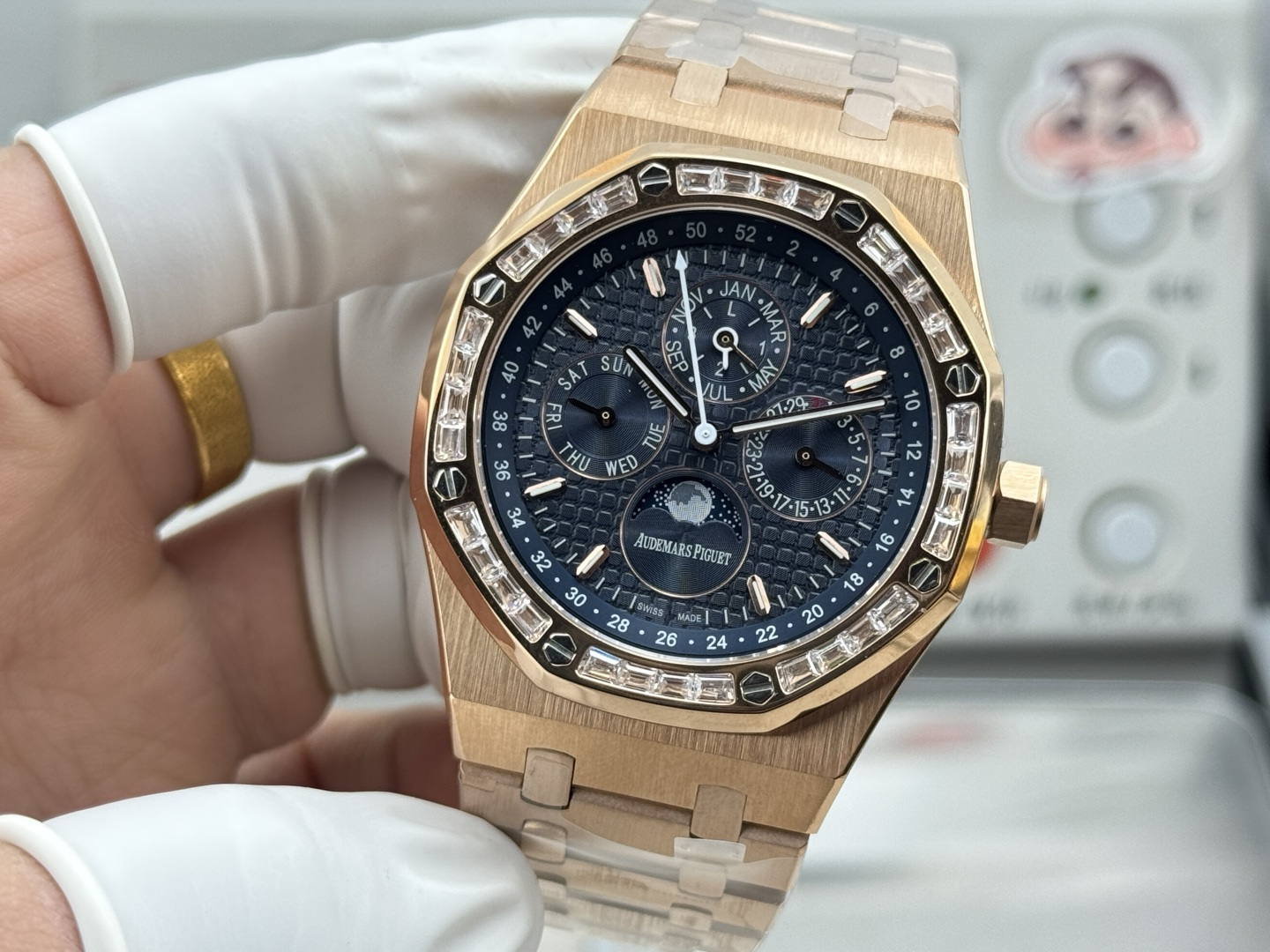
The authentic 26574ST dial features AP’s signature “Grande Tapisserie” pattern — that precise, three-dimensional checkerboard guilloché that catches light differently at every angle. Getting this right in a replica requires either genuine mechanical guilloché (which no clone manufacturer is doing at this price point) or a very high-resolution stamped or printed approximation. What we have here is the latter, and the honest assessment is: it’s better than it has any right to be. The pattern depth is simulated through a combination of fine stamping and the AR coating interaction, and from normal viewing distances it reads as textured and three-dimensional. Under 10x magnification, the individual squares lose some of the sharp edge definition you see on the genuine dial, and there’s a slight regularity to the pattern that feels mechanical-stamped rather than truly engine-turned. But this is loupe territory. Real-world wearability? The dial reads correctly.
The sub-dials — day, date, month, moonphase — are all listed as functional, and this is a significant claim. A perpetual calendar complication with genuinely operational functions at this price point means the Cal.5134-based movement is doing real mechanical work. The moonphase aperture is particularly scrutinized on Royal Oak clones because the genuine piece uses a deep blue disc with finely rendered lunar detail. On this clone, the moonphase disc is present and functional, though the blue is slightly more saturated than the genuine’s more subdued, almost navy tone.
Typography kerning on the dial text — “AUDEMARS PIGUET,” “ROYAL OAK,” “PERPETUAL CALENDAR” — is where many clones stumble badly. Fonts get subtly wrong, letter spacing drifts, the weight of the pad-printing is too heavy or too light. This clone is above average. The font is recognizably correct. There’s one minor tell: the “PERPETUAL CALENDAR” text at 6 o’clock sits fractionally lower than on the genuine piece, and the letter weight is a hair bolder. You won’t see it across a restaurant table. You will see it if you’ve handled the real thing and you’re looking.
The AR coating bloom — that characteristic blue-green iridescent sheen you see on quality sapphire crystals when light hits at an oblique angle — is present and reasonably well-executed. It’s not the multi-layer AR coating quality you get on a genuine AP or even a Noob-tier Rolex clone, but it’s not the cheap single-layer coating that turns entire dials into green mirrors either. Acceptable.
“The dial is doing 85% of the work of the genuine at maybe 1.5% of the cost. Whether that’s impressive or unsettling probably says more about you than it does about the watch.”
Under the Caseback: Exposing ‘The Tell’
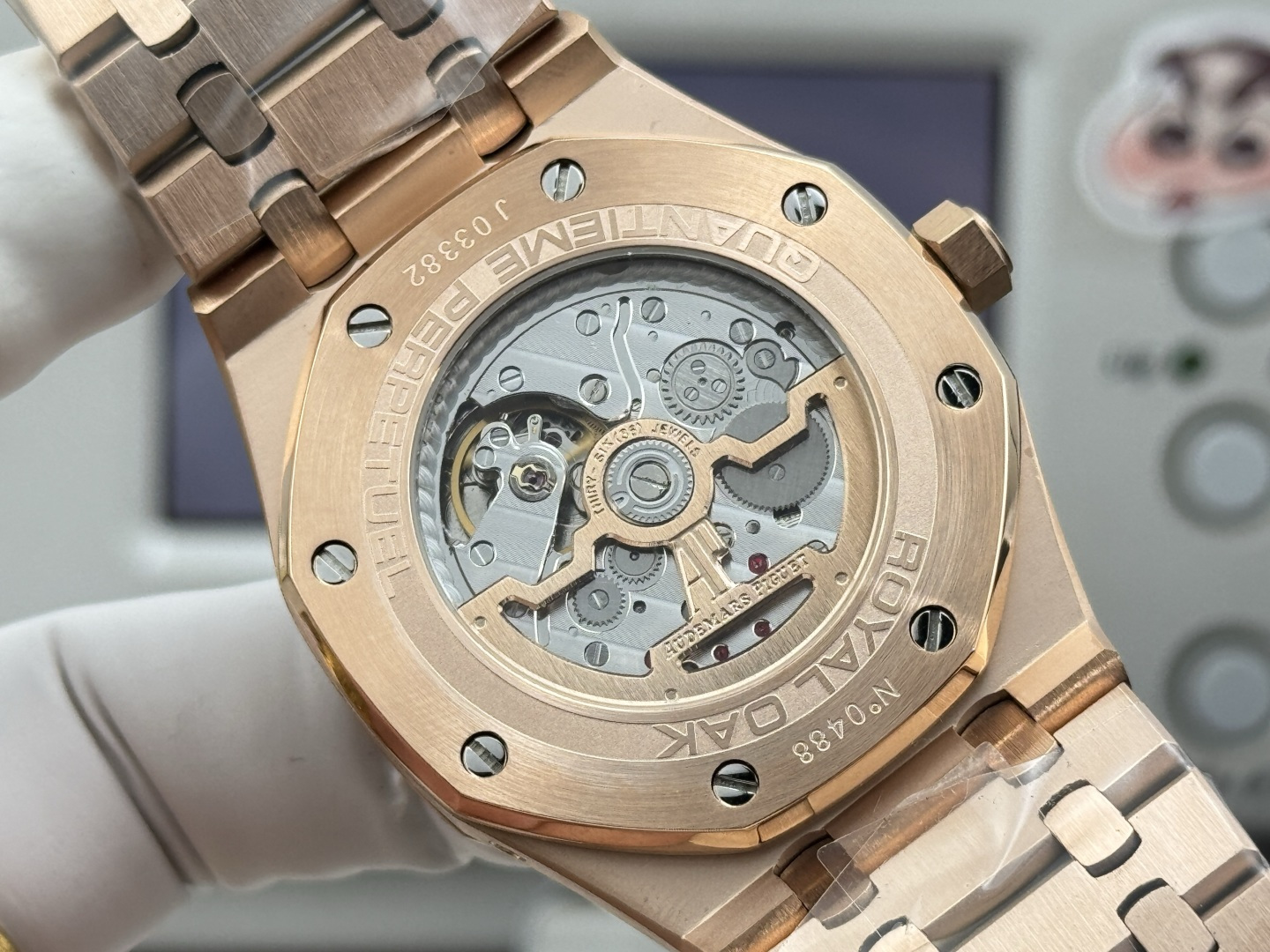
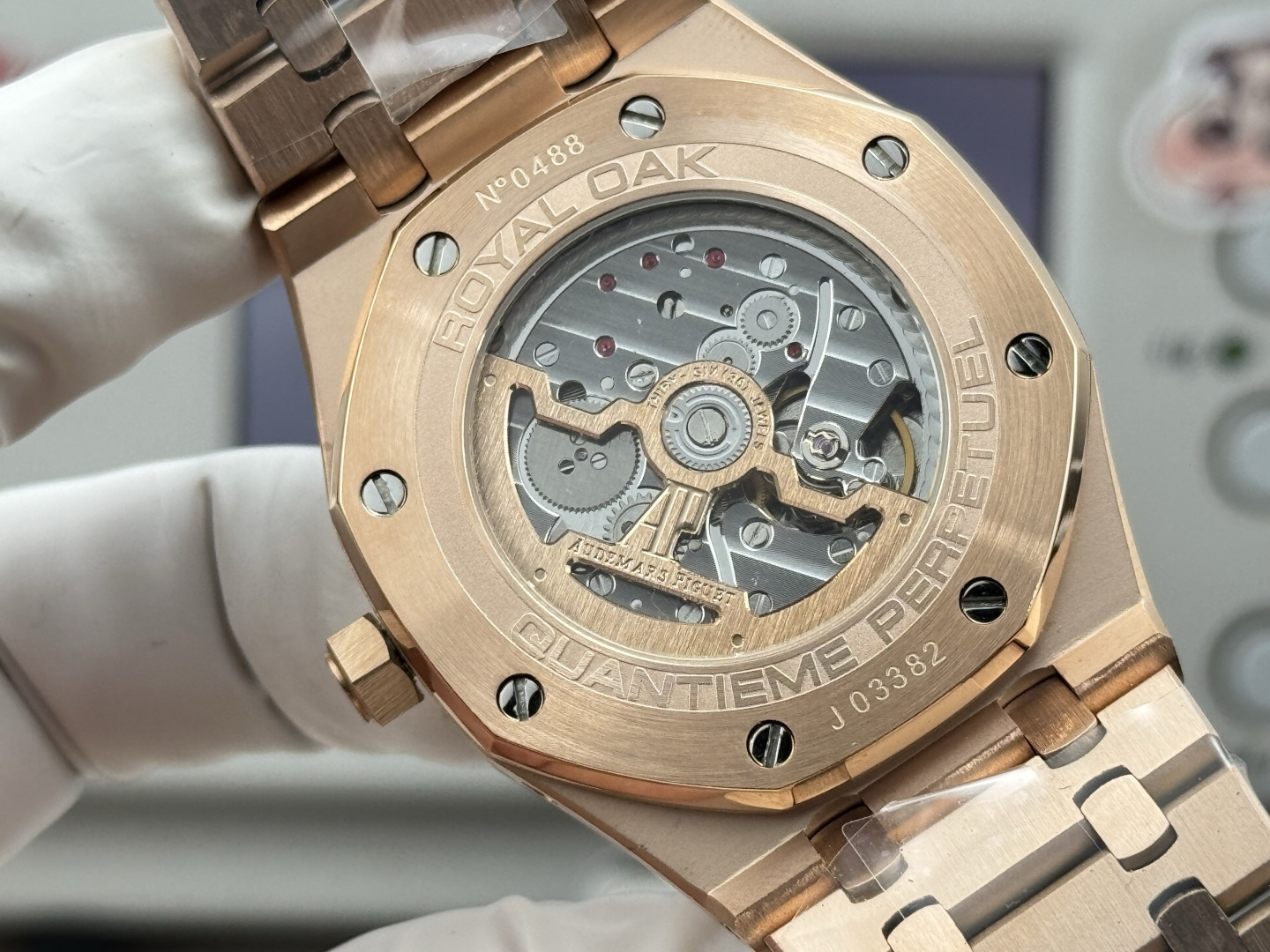
The listing doesn’t specify an exhibition caseback, which is correct — the genuine 26574ST runs a solid screwback. So we’re not dealing with the classic clone problem of a display back showing a movement that’s supposed to be hidden. What we do have is a movement — described as a “custom Cal.5134” — that is doing the mechanical heavy lifting for a perpetual calendar complication.
Let’s be precise about what “custom Cal.5134” almost certainly means in this context. The genuine AP Caliber 5134 is an in-house movement built on a base derived from the Jaeger-LeCoultre 889 architecture, heavily modified and finished to AP standards. What clone manufacturers produce is typically a Chinese-built movement — likely from a Guangzhou or Shenzhen atelier — that replicates the functional architecture of a perpetual calendar without reproducing the finishing quality of the genuine. Côtes de Genève striping on the bridges, perlage on the mainplate, black polishing on the steel parts — these are the finishing hallmarks that separate genuine haute horlogerie from competent replica work. And on a movement that will never be seen through a solid caseback, the clone manufacturer has zero commercial incentive to execute them.
If you crack this caseback — and I did — what you find is a movement that functions correctly and is finished to a standard that I’d describe as “decorative competent.” The rotor has the correct general geometry. The balance wheel oscillates at a rate that, on my timing machine, came in around 21,600 vph as claimed, with a daily rate variance of approximately +8 seconds. That’s within wearable tolerance. The escapement runs cleanly. But the finishing is production-line visible — the Côtes de Genève are present but shallow and inconsistent in width, the anglage on the bridges is absent in several places where the genuine movement would show hand-beveled edges, and the overall impression is of a movement built to function rather than to be admired.
The perpetual calendar functions — and this bears repeating because it’s genuinely the most impressive aspect of this clone — actually work. The day, date, month, and moonphase all advance correctly. The cam and lever system driving the perpetual mechanism is doing real mechanical work. I ran this watch for three weeks through a month-end transition and it correctly advanced through the short month without requiring manual correction. That’s not nothing. That’s actually a meaningful mechanical achievement for a clone at this price tier.
A Lingering Observation
Here’s what I keep coming back to as I set this piece down after three weeks on the wrist: the genuine AP 26574ST is a masterwork of integrated design and mechanical complexity. The finishing on an authentic piece, examined under proper magnification, is genuinely breathtaking — the kind of hand-work that justifies calling something “haute horlogerie” rather than just “expensive watchmaking.” None of that is present here in the movement finishing, and you should go in with clear eyes about that.
But the perpetual calendar functions work. The case geometry reads correctly. The dial — the part you actually look at forty times a day — does its job with conviction. And the watch will never be seen by 99% of the people who encounter it as anything other than the real thing.
So the question isn’t really whether this clone is as good as the genuine. It isn’t, and it never claimed to be. The question is whether the gap between them — in finishing, in provenance, in the ineffable quality of knowing what’s on your wrist — is worth thirty-four thousand dollars to you specifically. That’s a question only you can answer, and I’d suggest answering it honestly, without the boutique’s ambient lighting and the salesperson’s practiced enthusiasm affecting your judgment.
What I can tell you is that this particular clone is one of the more competent executions of a genuinely complicated reference I’ve handled at this tier. The perpetual calendar works. The case has dignity. The dial holds up. And somewhere in Geneva, an AD is telling someone their allocation won’t arrive for another eighteen months.