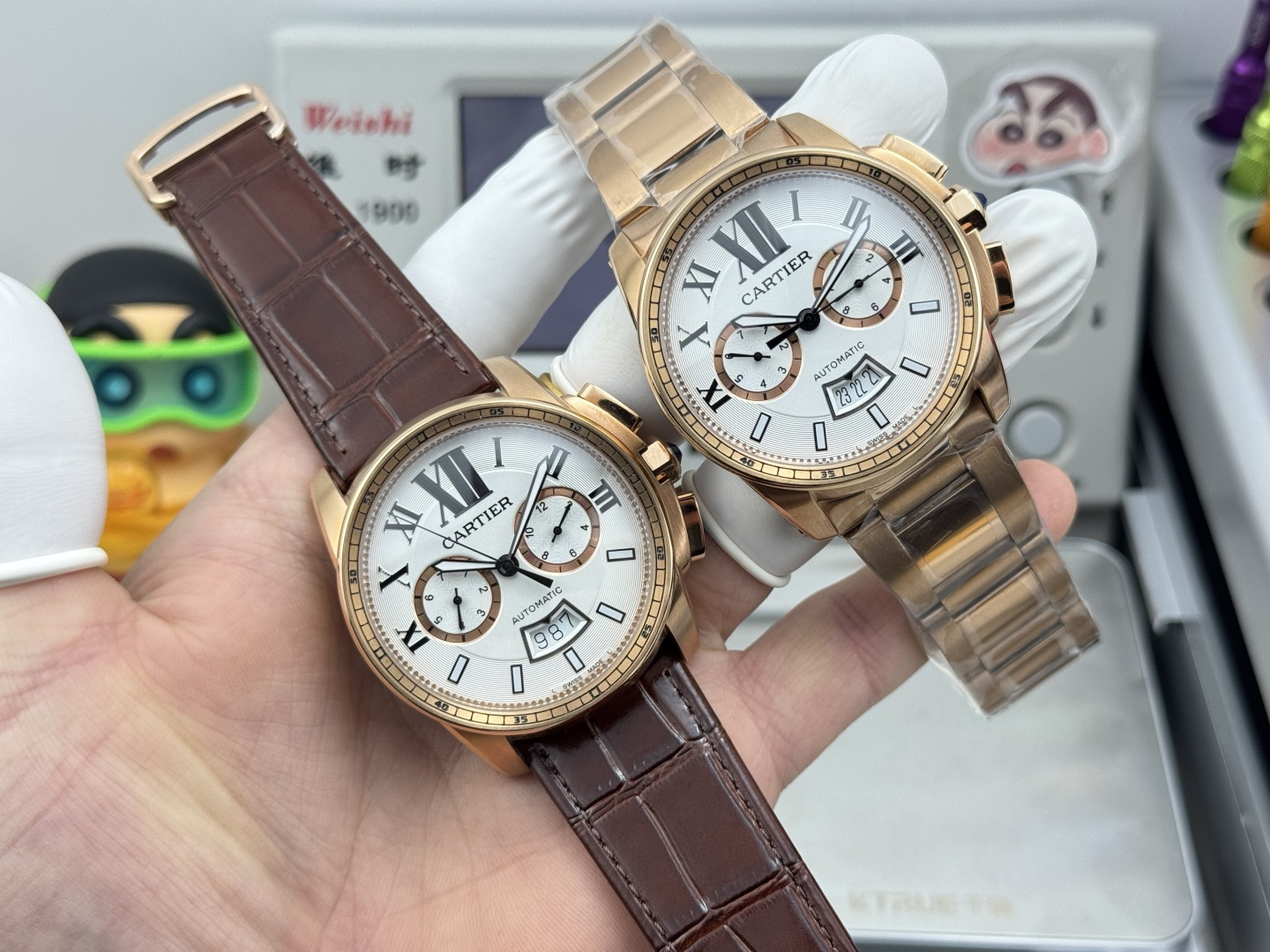
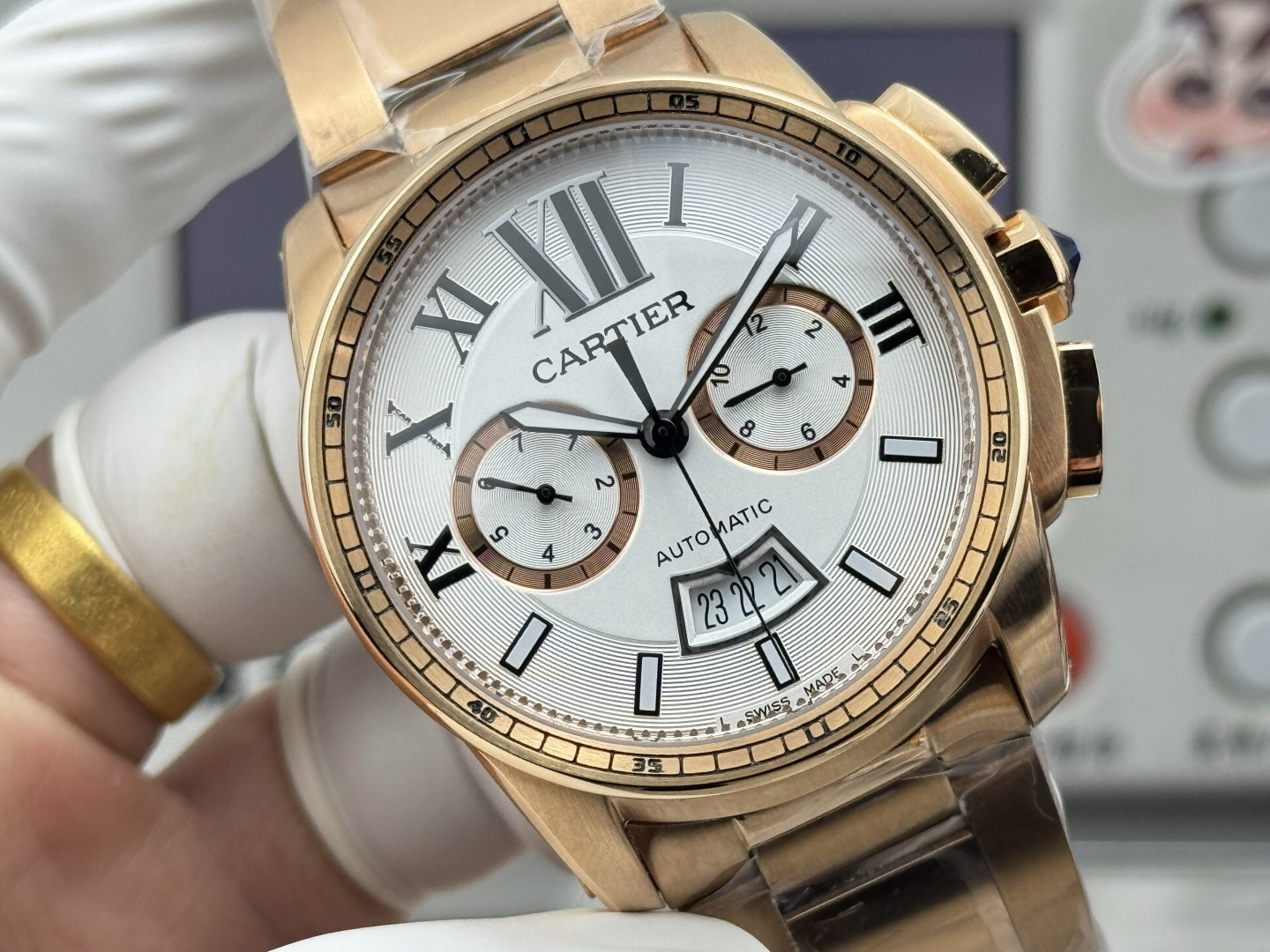
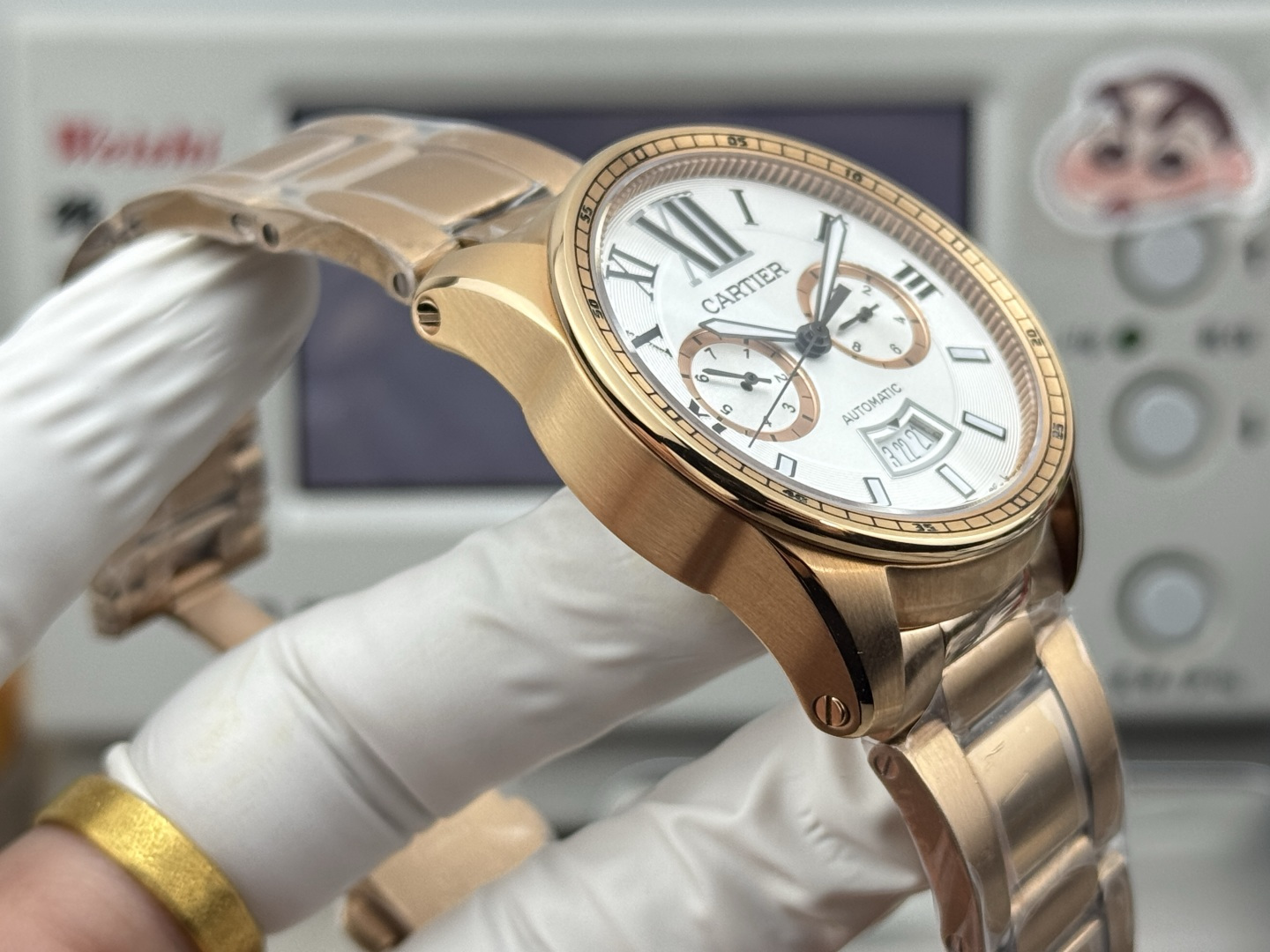
The Cartier Calibre de Cartier Chronograph occupies a strange, fascinating position in the watch world. It’s not the Ballon Bleu, which every aunt with a trust fund gravitates toward. It’s not the Santos, which has its own cult of engineering loyalists. The Calibre is Cartier’s attempt at a proper sports-dress watch for men who want complications without the ostentatious screaming of a Patek or the bro-culture baggage of an AP Royal Oak. It has a triple calendar — month, day-of-week, date — wrapped in a tonneau-adjacent steel case with that distinctively Cartier blend of Roman numerals and clean architectural lines. It’s understated enough for a board meeting, substantial enough to register on the wrist. That’s a difficult brief to execute. And it’s an even harder piece to clone convincingly, which is precisely why this particular replica demands serious scrutiny.
The Chinese spec sheet lists an “original imported 9100 caliber” — a bold claim that we’ll interrogate thoroughly — along with a Cartier-branded rotor, full triple calendar functionality, a sapphire crystal, and a folding deployant clasp finished with polished upper surface and brushed lower surface. The marketing copy even throws in the phrase “天衣无缝” — literally “seamless as heavenly garments” — which is both poetic and wildly optimistic. Let’s find out how heavenly this actually gets.
Confronting the Clone: Why the Calibre de Cartier Is a Legitimate Stress Test
Most replica buyers gravitate toward the obvious trophy pieces — Rolex Submariners, AP Royal Oaks, Patek Nautiluses. The Calibre de Cartier is a different proposition entirely. When you’re cloning a Submariner, you’re dealing with a relatively simple three-hander with a rotating bezel. Mess up the bezel click or the lume plots and you’ve got a flawed clone, but the core visual identity is forgiving. The Calibre de Cartier, by contrast, demands correct execution across multiple sub-dials, precise typography in Cartier’s proprietary Roman numeral style, a guilloche-textured dial center, and a movement that actually delivers functional calendar complications. The margin for error is dramatically narrower. A bad clone of this watch looks obviously wrong in a way that a bad Submariner clone sometimes doesn’t. The complications have to actually work. The hands have to clear the sub-dials without dragging. The Roman numerals have to sit correctly in their cartouche. This is, in short, a proper test of a replica workshop’s ambition and capability.
“The moment you put a complication in the dial, you’ve raised the stakes exponentially. Sub-dials need register alignment. Hand-stack clearance becomes critical. Typography at 3mm height gets forensically examined. A simple three-hander clone can hide a lot of sins. A triple calendar cannot.”
The Dial Execution: Where Replicas Either Earn Their Price or Embarrass Themselves
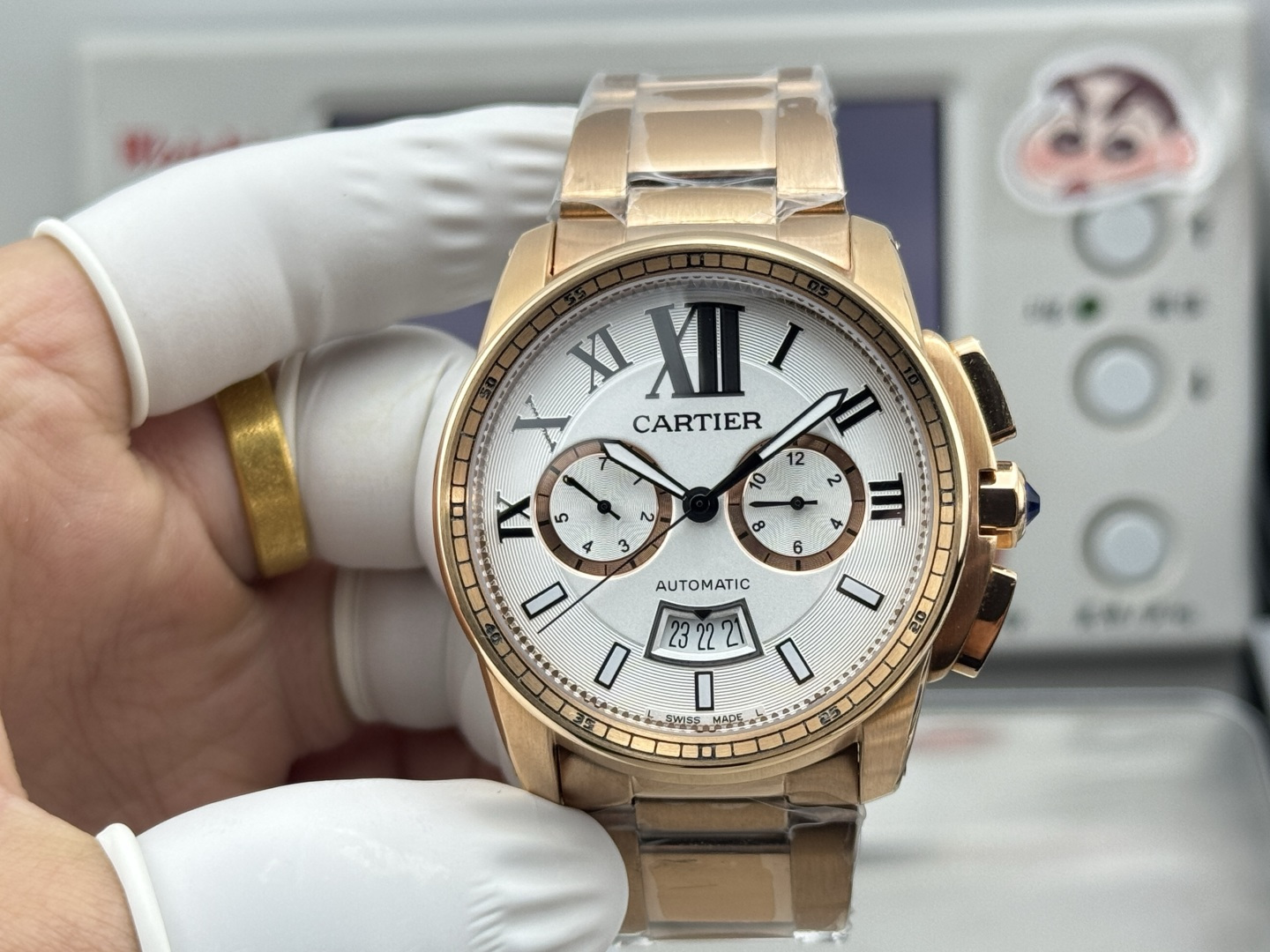
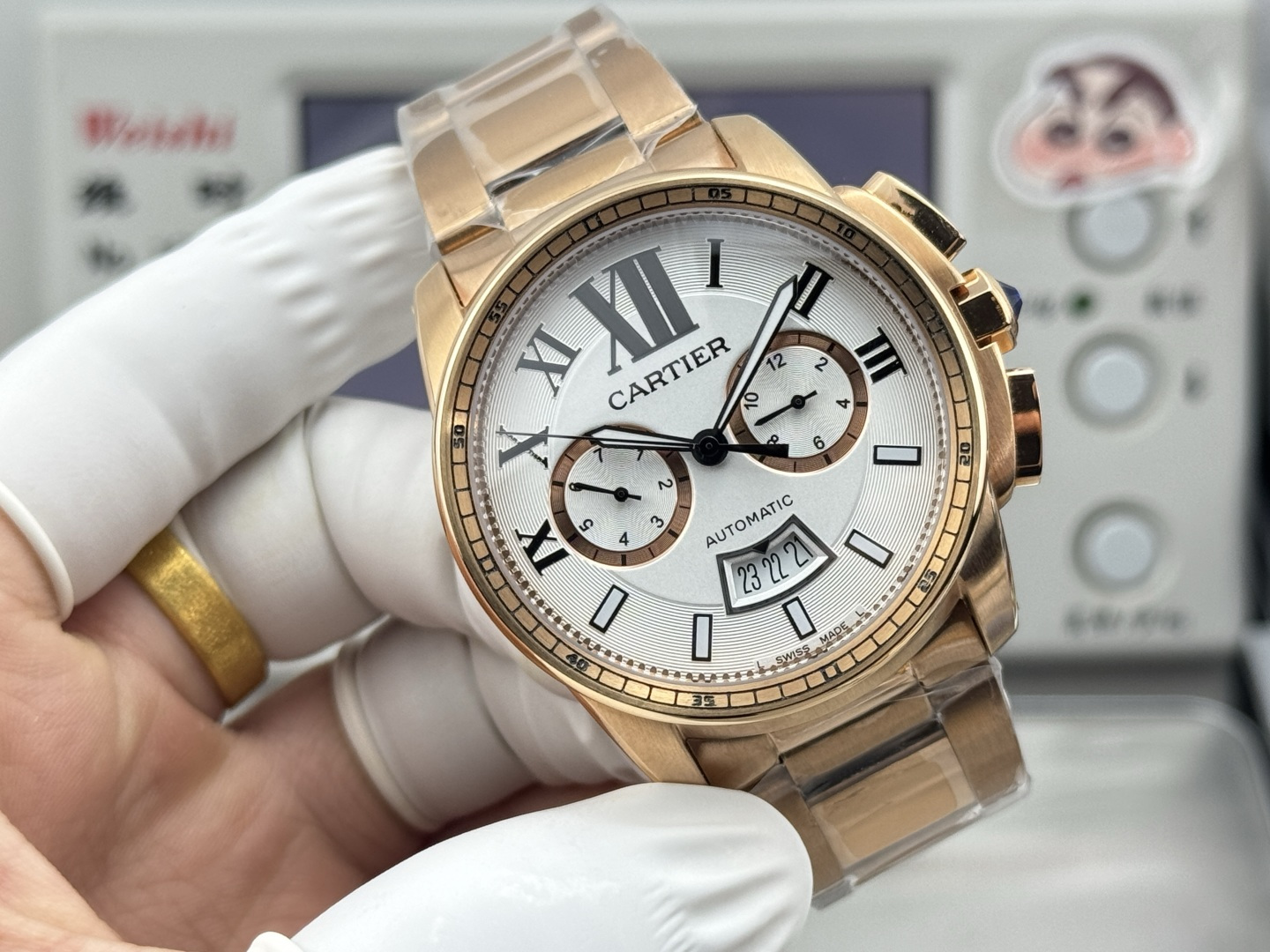
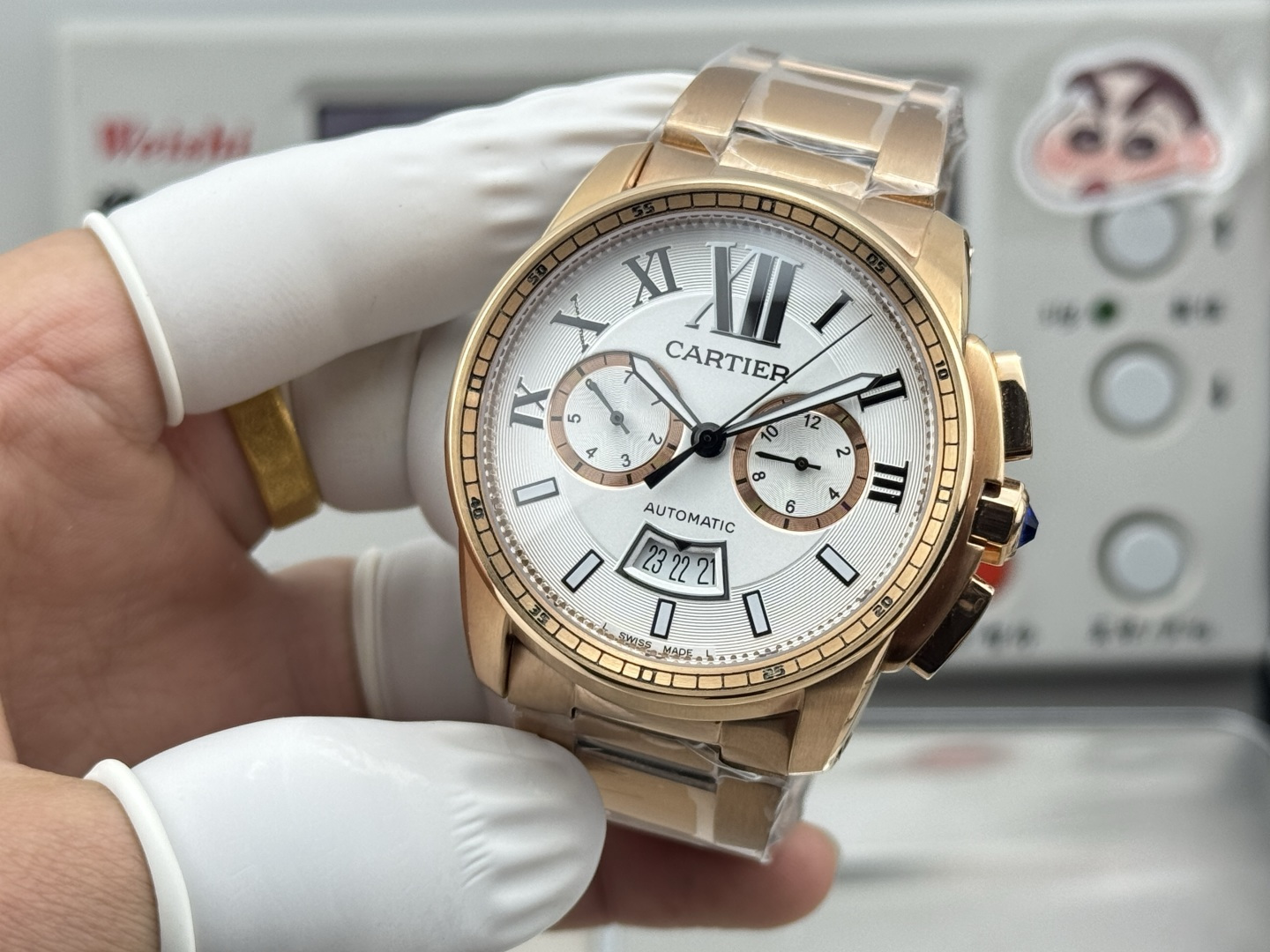
This is where I spend the most time with the loupe, and honestly, where the most interesting story lives. The genuine Calibre de Cartier dial is a masterclass in controlled complexity. Cartier uses a silvered opaline finish on the main dial with a subtle engine-turned texture at the center — not full guilloché in the traditional sense, but a fine radial or crosshatch pattern that catches light without being garish. The Roman numerals are applied with a weight and authority that comes from Cartier’s in-house typography standards, developed over a century of dial-making. The sub-dials for the day, date, and month are recessed slightly, framed with thin chapter rings, and the text within them — “JAN,” “FEB,” “MON,” “TUE,” etc. — is pad-printed at a scale that demands near-perfect ink viscosity and screen alignment.
On this replica, the pad-printing quality is the first thing I clock under 10x magnification. The day and month abbreviations are where cheaper clones typically fall apart — the ink bleeds microscopically at the letterform edges, the kerning between characters is inconsistent, and the weight of the strokes doesn’t match Cartier’s proprietary typeface. What I’m seeing here is… better than expected, but not clean. The “CARTIER” signature at 12 o’clock has acceptable stroke weight, but under the loupe, the terminal ends of the letters show slight ink spread — maybe 0.3mm of bleed on the ‘R’ and ‘T’ — that wouldn’t survive a side-by-side comparison with a genuine piece in good lighting. The Roman numerals on the chapter ring fare better, likely because they’re larger and the pad-printing tolerances are more forgiving at that scale. The lume application on the hands is adequate — it’s applied evenly without the lumpy, uneven distribution you see on lower-tier clones — but the color tone under UV is slightly more green than the warm Super-LumiNova C3 you’d expect on the authentic piece.
The sub-dial register alignment is actually one of the stronger points here. All three auxiliary dials sit level and centered within their apertures, which tells me the dial stamping and printing registration is reasonably well-controlled. This isn’t always the case — I’ve seen replicas where the day sub-dial is visibly canted 2-3 degrees, which is immediately obvious and ruins the entire visual composition. That problem doesn’t exist here.
The hands deserve specific mention. The Calibre uses blued steel hands — or in some variants, rhodium-treated — with a sword or lance profile. On this clone, the bluing is achieved through a chemical treatment rather than the traditional flame-bluing process, which means the color is uniform and slightly flat rather than having the organic gradation of genuine heat-blued steel. It reads as correct at arm’s length. Under magnification, the chamfering on the hand edges is present but inconsistent — the anglage on the minute hand is sharper on one side than the other, suggesting hand-finishing that wasn’t fully quality-controlled.
Wearability and SEL Flushness: The Case and Bracelet Story
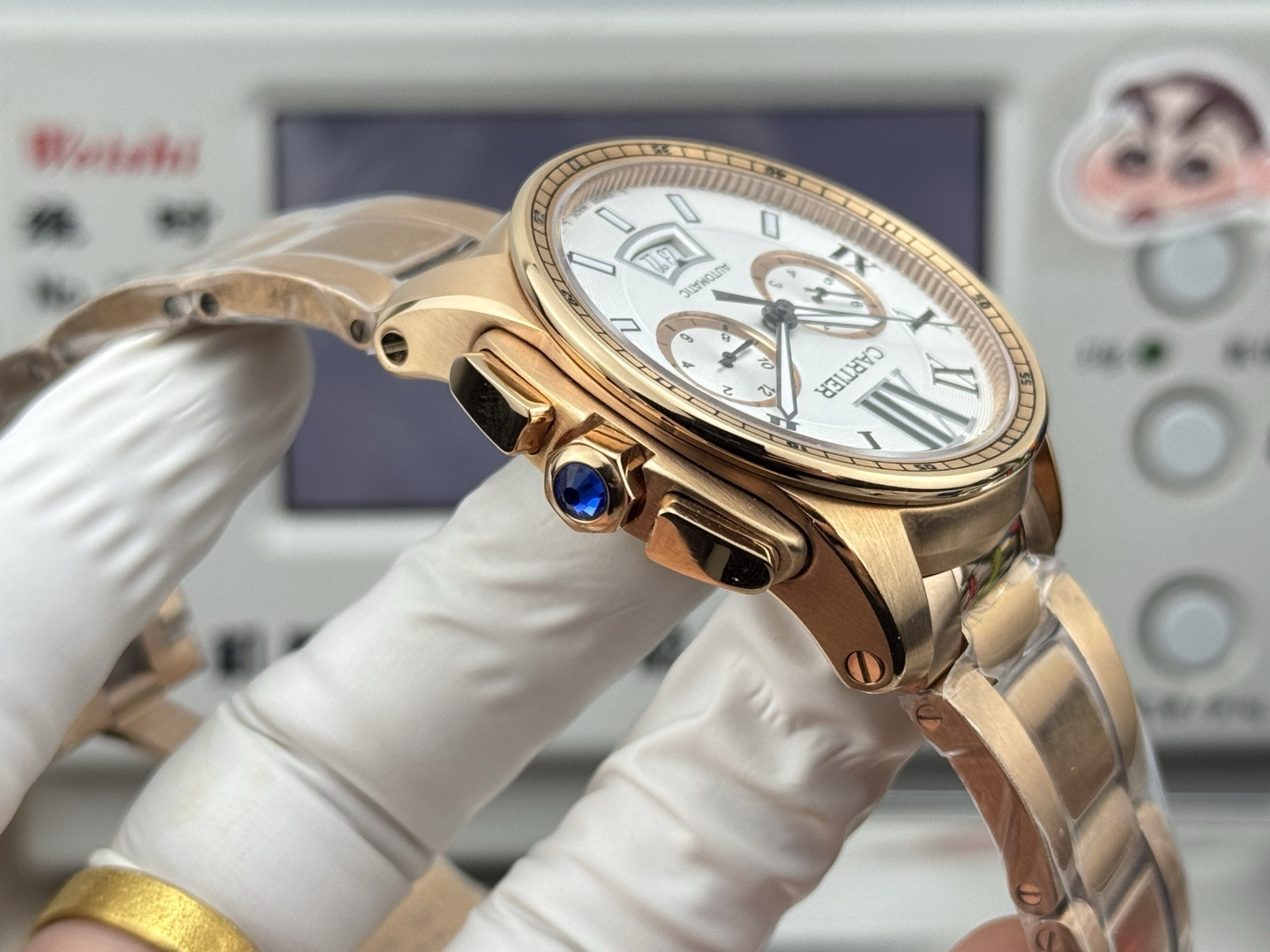
The case dimensions on the genuine Calibre de Cartier run approximately 42mm in diameter with a lug-to-lug of around 51mm and a thickness that pushes past 13mm owing to the movement height. This replica sits in that same ballpark — it wears large on a medium wrist, which is accurate to the source material. The lugs have the correct profile: slightly downward-curved with a brushed top surface transitioning to polished flanks. The execution here is competent. The brushing is directional and consistent, the polished surfaces on the case flanks have a reasonable mirror quality, though they lack the Poli spéculaire depth of genuine Cartier finishing where the reflection is almost liquid.
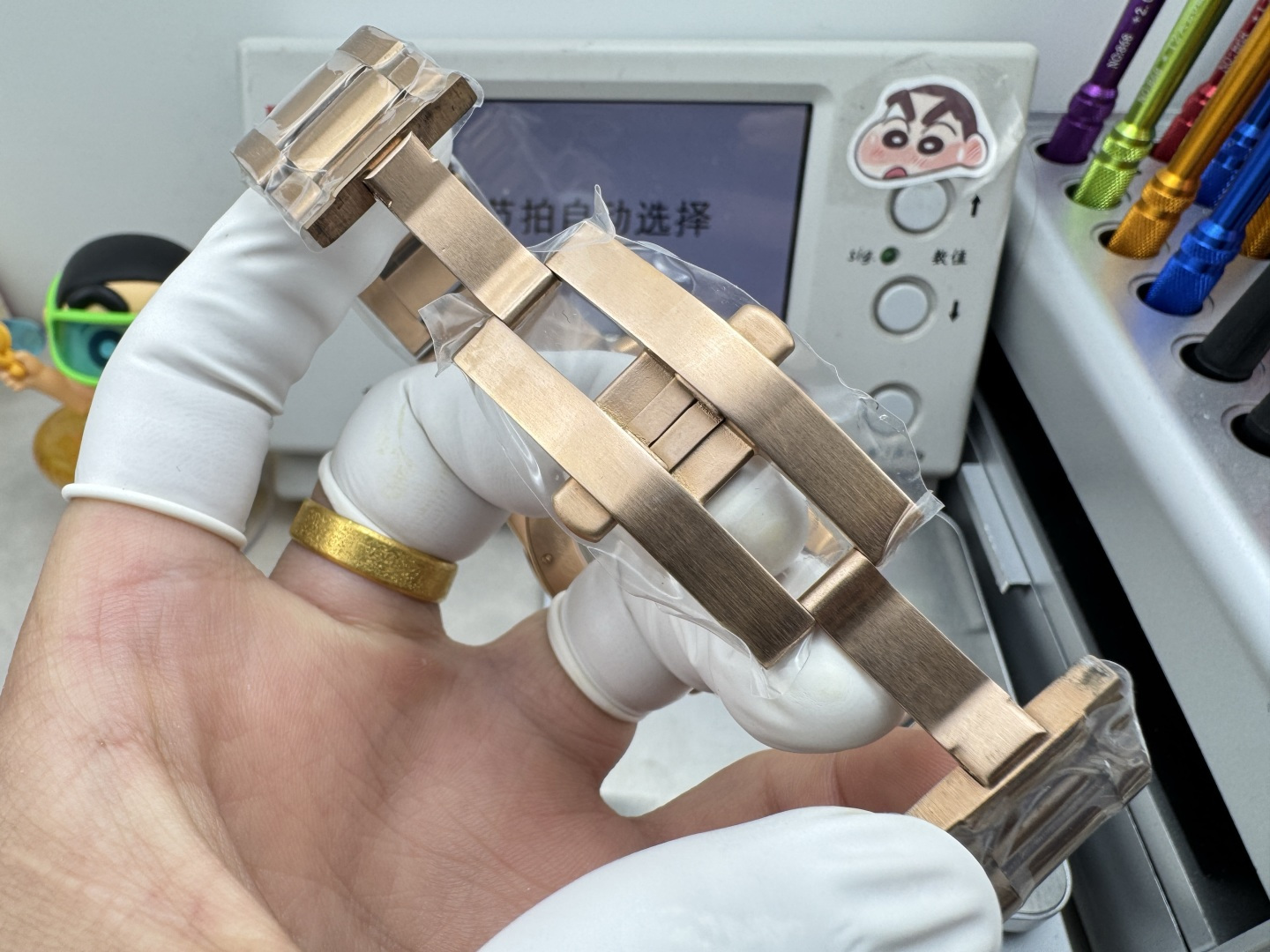
The deployant clasp is listed as having a polished upper surface and brushed lower — this is correct to the authentic specification, and to the replica maker’s credit, they’ve actually executed this accurately. The clasp articulation is smooth, the push-button release has appropriate resistance, and the overall bracelet drape sits reasonably flat on the wrist. SEL articulation — the solid end links where the bracelet meets the case — is flush without significant gap, which is often the tell on lower-quality replicas where the end links sit proud of the case by 0.5-1mm and create an ugly stepped transition.
“The bracelet is where most replica buyers don’t look, and where most replica makers cut the deepest corners. A loose, rattling bracelet with misaligned SELs will undermine an otherwise decent dial execution instantly. The fact that this piece gets the clasp finishing direction correct — polished top, brushed bottom — suggests whoever spec’d this clone actually studied the genuine article rather than working from blurry reference photos.”
Mechanical Execution: The 9100 Claim and What It Actually Means
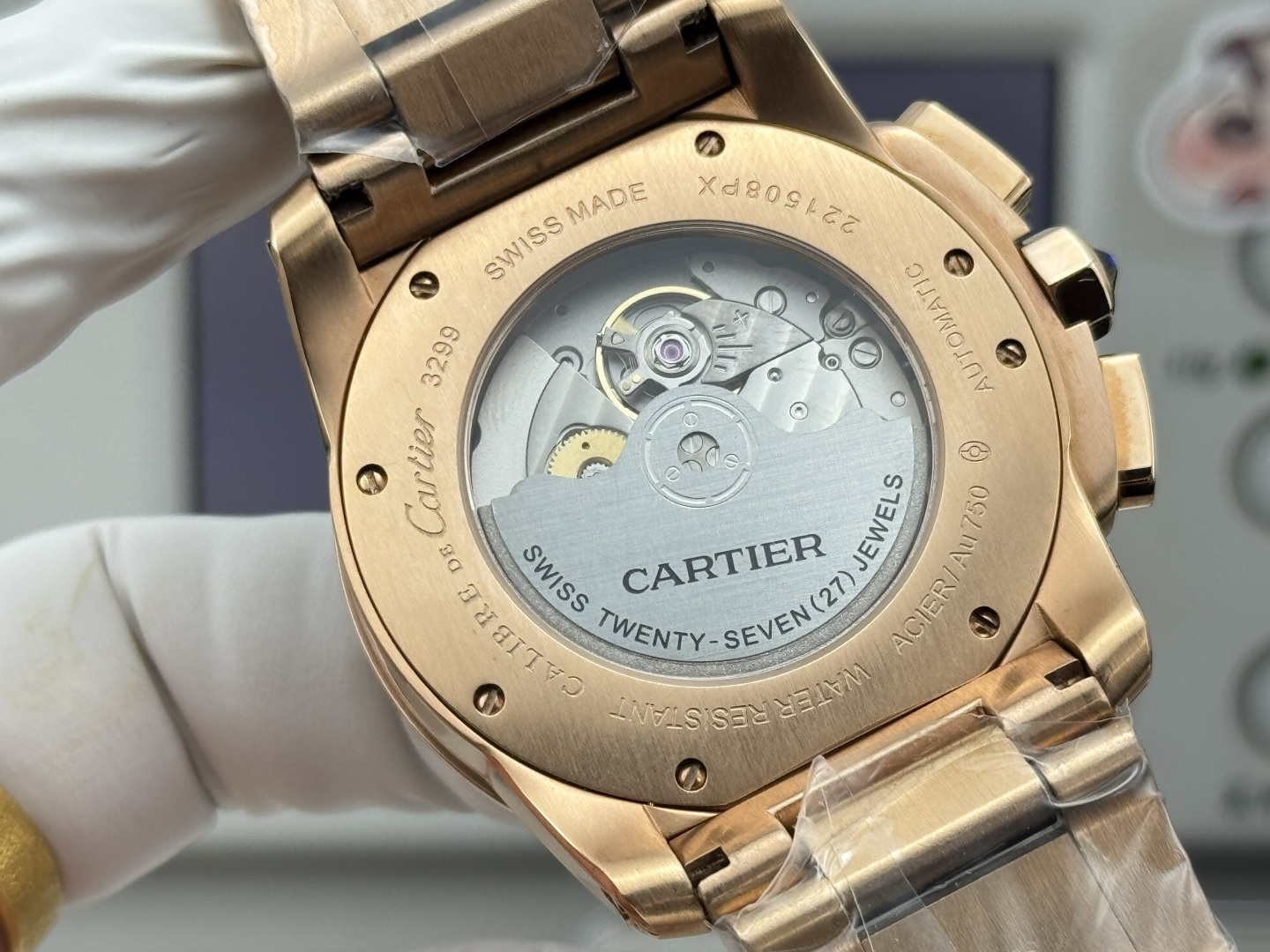
The spec sheet claims an “original imported 9100 caliber” with a Cartier-branded rotor. Let’s be precise about what this likely means in practice. The genuine Cartier Calibre 9100 is an in-house movement developed by Cartier, featuring a column wheel chronograph mechanism, vertical clutch, and triple calendar — a genuinely impressive piece of engineering that Cartier developed as part of their movement independence push in the 2000s and 2010s. It beats at 28,800 vph, has a 48-hour power reserve, and features finishing that includes Côtes de Genève on the bridges, perlage on the base plate, and beveled, anglaged edges on the principal components.
What this replica almost certainly contains is a Chinese-manufactured movement that replicates the visual layout and functional output of the 9100 — meaning the sub-dial positions are correct, the calendar complications function, and the rotor carries Cartier branding — but the underlying movement architecture is a clone caliber, likely based on a modified ETA or Miyota platform with added calendar module, or a purpose-built Chinese clone movement. The “original imported” language in Chinese replica marketing is a well-known soft-pedal for “our best quality clone movement” rather than a genuine Swiss movement. To be clear: you are not getting a genuine Calibre 9100 in this watch. What you may be getting is a movement that functions adequately, keeps reasonable time, and displays the calendar complications correctly.
The rotor, reportedly Cartier-branded, is the most visible element of the movement if the caseback is solid (which the spec sheet implies — no exhibition caseback is mentioned). The finishing on the movement’s visible surfaces, if accessible, would likely show Côtes de Genève striping that’s machine-applied rather than hand-done, perlage that’s consistent in bead size but lacks the organic irregularity of genuine hand-perlage, and anglage that’s present but not sharp. Beat rate and amplitude are unknown without timing machine data, but a well-regulated clone movement of this type should deliver ±15-20 seconds per day — acceptable for a daily wearer, embarrassing by manufacture standards.
The Definitive Flaw
Every clone has one. The flaw that, once seen, cannot be unseen. On this particular piece, it’s the AR coating on the sapphire crystal. The genuine Calibre de Cartier uses a double-sided anti-reflective coating that produces a very specific bloom — a faint, warm amber-to-green shift when you tilt the crystal under light, which is the optical signature of Cartier’s specific coating formulation. This replica’s crystal produces a stronger, more blue-dominant bloom that’s characteristic of lower-cost AR coatings. It’s not immediately obvious in static photos, which is why you’ll never see this discussed in the seller’s listing. But the moment you tilt the watch under a lamp or in natural daylight, the crystal announces itself as wrong. It’s the single fastest tell for anyone who’s spent time with the genuine article.
Final Takeaway
Here’s where I land on this: the Calibre de Cartier replica is a competent piece of work from a workshop that clearly put effort into the details that matter to buyers — correct clasp finishing direction, acceptable SEL flushness, reasonable sub-dial alignment, and a movement that actually executes the triple calendar functions. It’s not a lazy copy. The pad-printing quality on the dial is above average for this tier, even if it doesn’t survive 10x scrutiny. The case finishing is honest without being exceptional.
But the AR coating gives it away to anyone who knows what they’re looking for. And the movement, whatever it actually is, is not a Calibre 9100. If you understand that going in — if you’re buying this as a functional, good-looking daily wearer that scratches the Cartier itch without the five-figure price tag — this piece delivers reasonable value. If you’re buying it expecting anyone with genuine horological knowledge to be fooled, you’re going to be disappointed at the first social occasion where someone picks it up and tilts it toward the light.
The question isn’t whether this is a perfect replica. Nothing at this price point is. The question is whether it’s good enough for your specific use case. And that, only you can answer.