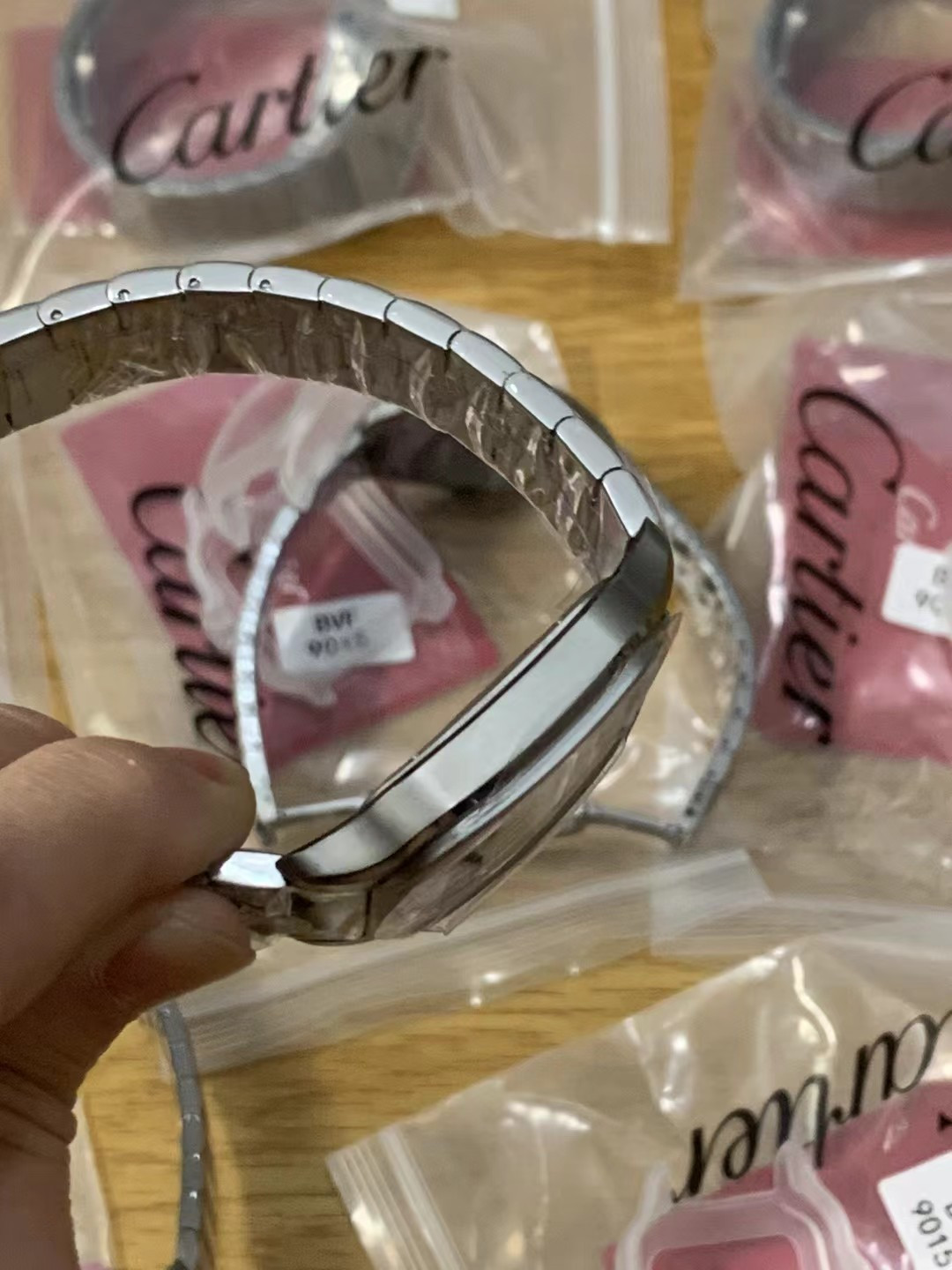
The Santos de Cartier has always occupied a singular position in watchmaking history — not merely as one of the first purpose-built wristwatches, but as a design so architecturally resolved that it has resisted the erosion of changing taste for over a century. Its exposed screws, its squared case, its bold dial grid: these are not decorations but structural arguments. When Cartier occasionally revisits the Santos with a new material or finishing philosophy, the horological world pays attention. BVF, a manufacturer that has built a credible reputation for high-fidelity replica production, has now entered that conversation with something genuinely unexpected — a titanium-cased Santos in white dial configuration, finished almost entirely in matte sandblasting, abandoning the familiar interplay of brushed and polished surfaces for something rawer, more purposeful, and quietly compelling.
A New Skin for a Century-Old Architecture
The first thing one notices when the watch arrives is how different it feels in the hand compared to any previous Santos iteration. Titanium, as a material, carries a particular paradox: it is substantially lighter than steel yet communicates a density that feels deliberate rather than hollow. BVF’s decision to work in this alloy is not merely cosmetic — it reframes the Santos’s character entirely. Where the standard steel reference leans into its polished bevels and mirror-bright flanks to project luxury, this titanium variant retreats into restraint. The case surfaces have been treated predominantly with a fine matte sandblasting, a technique that scatters light diffusely rather than reflecting it in sharp planes, giving the entire case a soft, almost mineral quality under ambient lighting.
The signature Santos case architecture remains intact and faithfully reproduced: the square cushion form, the rounded lugs that integrate organically into the bracelet, and — most critically — the exposed octagonal screws on the bezel that have defined the model since 1904. In this titanium execution, those screws take on a subtly different character. Without the high-polish contrast that typically makes them pop against a brushed case, they sit more quietly within the overall composition, their heads catching light with the same diffused matte quality as the surrounding metal. It is a more cohesive, tool-oriented aesthetic, and it works. The crown, positioned at three o’clock in classic Santos fashion, is properly proportioned and operates with the firm, mechanical resistance one expects from a well-fitted winding mechanism. The solid end links where the bracelet meets the case are cleanly executed, sitting flush without the gaps or misalignment that can betray lesser replica construction at a glance.
The White Dial: Geometry Under Light
If the case is the Santos’s skeleton, the dial is its face — and here, BVF has chosen restraint over flourish. The white dial is clean and structured, its surface divided by the characteristic grid of raised lines that echo the bezel’s screw pattern and give the Santos its instantly recognisable visual identity. These lines are crisply rendered, with sufficient relief to cast fine shadows in raking light, lending the dial a quiet three-dimensionality that flat photography rarely captures. The applied Roman numerals at twelve and six are sharp-edged and sit at a consistent height, while the remaining hour positions are marked by applied indices — slender rectangular batons that catch the light cleanly against the white ground.
The typography across the dial is handled with appropriate care. The Cartier logotype sits at twelve o’clock with the characteristic serif weight of the genuine article, pad-printed with sufficient precision that individual letterforms hold their edges under magnification. The subsidiary text — model designation, movement indication — is similarly legible and proportionate, avoiding the crowded or slightly blurred quality that can undermine otherwise competent replica dials. Super-LumiNova fills the applied indices and hands, glowing with a consistent blue-green charge in low light that is functional rather than theatrical. The blued steel hands, a Santos hallmark, are convincingly rendered: their colour is even and deep, and their profile is appropriately slender, sweeping across the white dial with the kind of visual clarity that makes reading the time genuinely effortless. The sapphire crystal above the dial carries a light AR coating, its tint subtle enough to avoid the greenish cast that plagues some replica crystals — in most lighting conditions, the glass reads as effectively invisible, which is precisely the point.
Beneath the Case Back: The Miyota 9015 at Work
BVF has equipped this Santos with what they describe as a flagship-grade movement: the Miyota 9015 caliber, here presented in a configuration the manufacturer refers to as a customised execution. The 9015 is, by any honest assessment, one of the more capable movements available to the replica industry. It is an automatic caliber beating at 28,800 vibrations per hour, offering a power reserve in the region of 42 hours, with hours, minutes, seconds, and date functions — the latter displayed through an aperture at three o’clock on the dial. The rotor bearing is smooth, spinning with minimal friction and a satisfying weight that one can feel through the case when the watch is tilted. The escapement runs with the regulated consistency that has made this caliber a reliable choice, and the date change, while not instantaneous in the manner of a high-end Swiss mechanism, is clean and unhesitating at midnight.
What the 9015 cannot offer, in transparency, is the visual drama of the genuine Cartier manufacture caliber — but that is a known trade-off in this segment, and one that any informed buyer understands. What it does offer is dependability, reasonable accuracy within plus or minus ten seconds per day in typical conditions, and a movement architecture robust enough to withstand daily wear without demanding excessive attention. The rehaut inside the case is cleanly finished, and the case back closes with a satisfying, flush-fitting seal.
The Considered Verdict
BVF’s titanium Santos is not an exercise in imitation for its own sake. It is, rather, a considered reinterpretation of a genuinely significant design — one that uses the constraints of the replica market to explore a material and finishing philosophy that even Cartier has only recently begun to pursue in earnest. The all-matte titanium treatment transforms the Santos from an object of polished elegance into something closer to a precision instrument: quieter, more austere, and in its own way, more interesting. The white dial provides the necessary contrast, and the Miyota 9015 ensures the watch functions reliably day to day. For those drawn to the Santos’s geometry but seeking something that wears less conspicuously on the wrist — something that reads as a tool before it reads as a luxury object — this BVF release makes a genuinely strong case for itself.